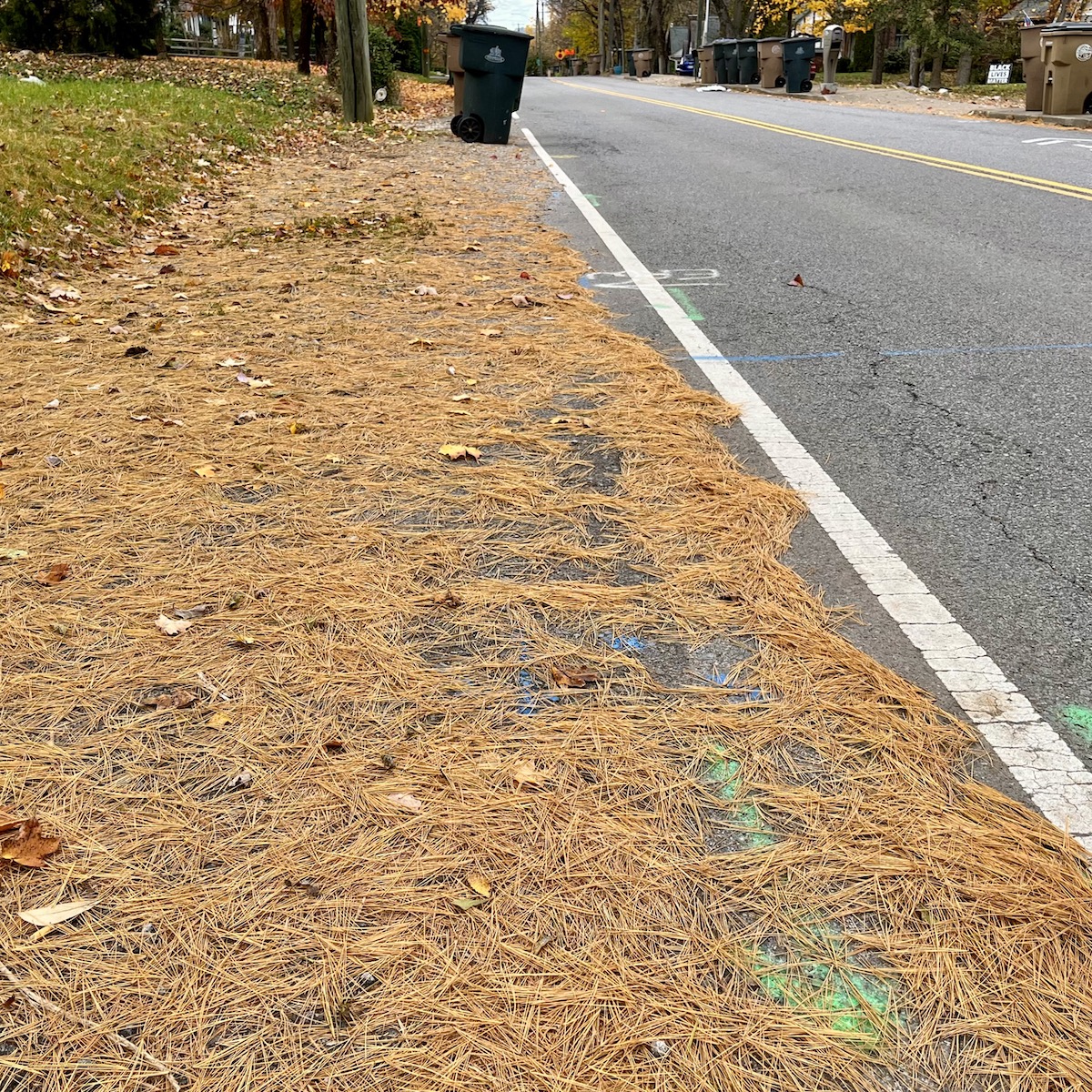
[Bagel from Bruegger’s, china from Spode, “wild chives” from the Mayflower]
I grew up eating what Mom called wild onion. It showed up in the yard as free food. The long, hollow leaves were good to chew, as were the bulbs, but those were too intense to eat raw unless cheese and crackers were involved.
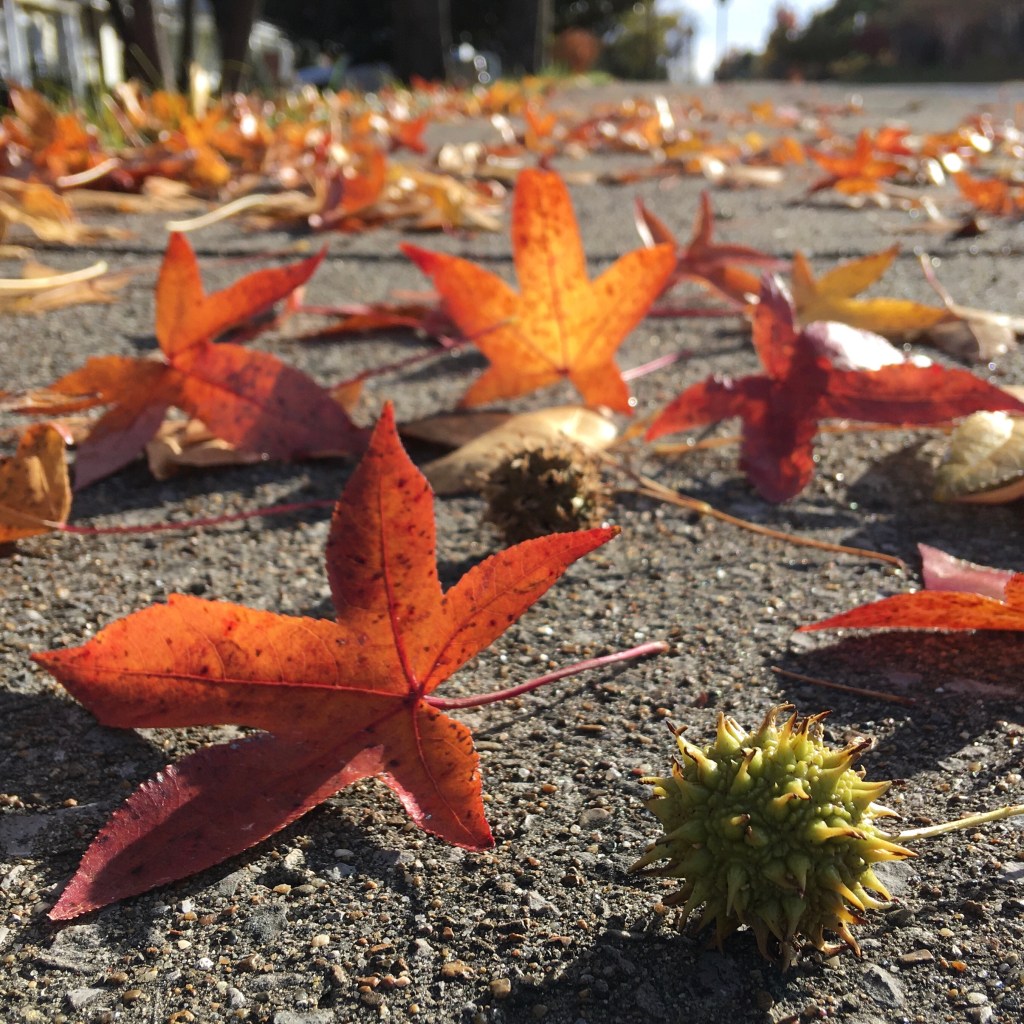
Sugar Maple leaves with pupa; Persimmon; Oak leaf with gall; Red oak acorns
“Wondering how trees help birds and wildlife survive a Nashville winter?”
That’s the first sentence in my short piece at The Nashville Tree Conservation Corps, called “How Your Tree Helps Wildlife in Winter.” My goal was to highlight “essential services” that only native trees can give to our birds, butterflies, and other animal neighbors.
Even if you already know the answers, take a look? Are there other stories I should have included in the allotted word count? We all want readers to fall in love with what native trees can do.
Folklore says the inside of native persimmon seeds can predict winter weather. Alas, Folklore doesn’t say *how* to slice the seeds, which can be tricky. Look for the shape of the embryo (and future “seed leaves”):
Fork = mild
Spoon = snow
Knife = “cutting” cold
The method is as accurate as Woolly-bear caterpillar predictions, which is to say, not at all. Both are fun, but with persimmons, you get to lick your fingers.
Every morning, I resist the temptation to pluck a fig from a sidewalk tree. I walk before dawn, but the plump silhouette is clear against the brightening sky.
“Pick meee!”
I’ve watched this fig grow from the size of a chocolate chip to the size of a . . . fig. There are dozens on offer: stem-down, bottoms-up candy for strangers. But I keep walking. Someone might be looking out a window.
Today was a different kind of June Bug Day: an upside-down kind. Instead of glossy, green grownups flying over grass, these June beetles are weird, white grubs crawling over streets. But the weirdest thing is how they crawl. Despite having six serviceable little legs, these larvae travel on their backs, upside down.
“Crawl” is too weak a word. Squoonch is better. The grubs squoonch, undulate, and wriggle forward while their feet point at the sky. The sky, meanwhile, is raining, which is why these teenagers leave their underground homes to squoonch somewhere less wet.
How do they do it? With “ambulatory bristles.” Isn’t that a wonderful phrase? Stiff hairs on the outside, plus strong muscles on the inside get the grubs where they wish to go.
But why do they do it? Why not walk on . . . ambulatory legs? No other grubs choose bristles over feet.
Please click the Play symbol to watch 5 seconds of Squoonching:
Here’s what you wonder: if Kousa (Japanese) dogwoods evolved in East Asia with wildlife there, what eats Kousa fruit here?
Because you already know that Nashville butterflies and moths can’t use Kousa leaves as caterpillar food.
And because you now suspect that the fruit piling up under neighborhood Kousa trees will keep piling up, uneaten. The fruits looks like round, warty raspberries but with long, cherry stems.
So, you watch and learn that: *squirrels ignore them, and *birds ignore them.
So, you ask the Internet and learn that: *monkeys were the main disperser in the native range, and *people can also eat the fruit.
Do you hear what I hear? Cicadas: morning, noon, and (almost) night.
These are the Dog Day cicadas: the annual species who show up every year. Their little husks in the yard and their big songs in the trees are signs of high summer, and to me, of Home.
But more importantly, they are a sign that one bit of our world is working as it should.
If you don’t hear what I hear, can you go out and try? Listen for the buzzes and grindings and trills where the trees are: mature, native trees like Sugar maples, elms, red-cedars. For maximum effect, listen at dusk on a Greenway or near some woods, or under fat hackberries in a shady neighborhood, where the combined cicada volume can almost rattle your bones. We’re talking Spinal Tap “eleven.”