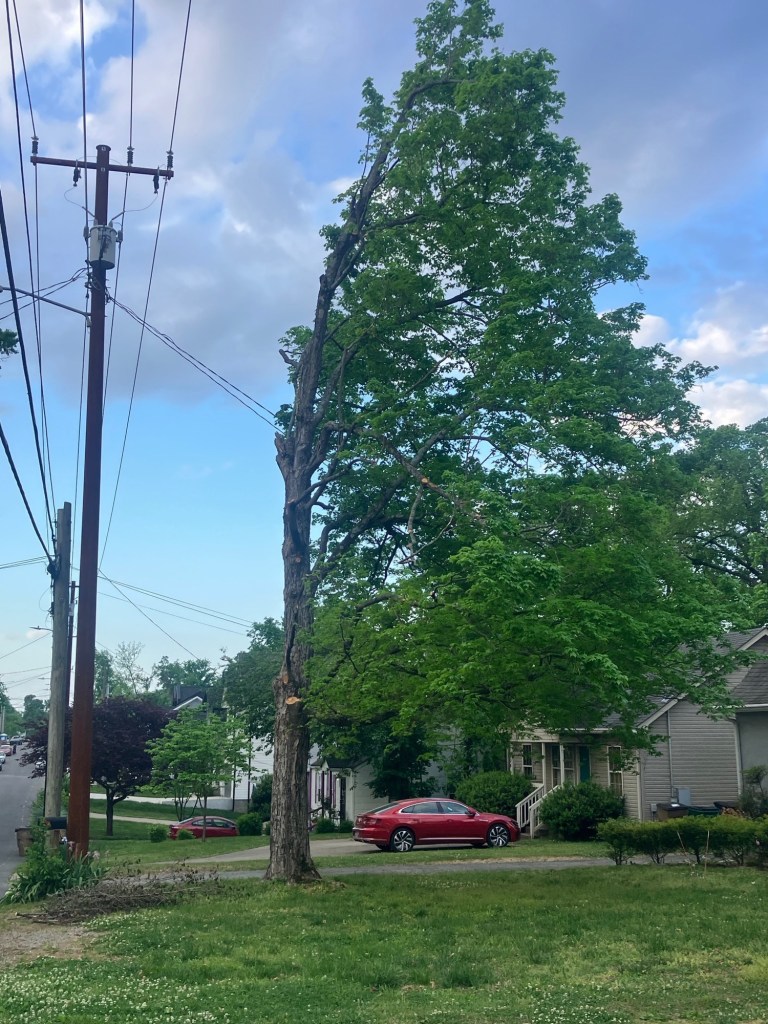
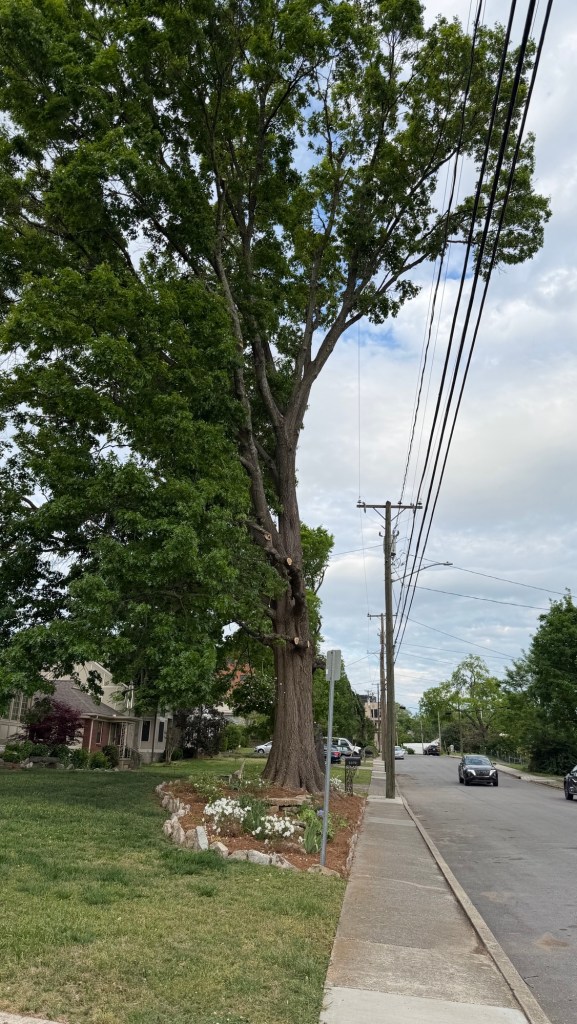
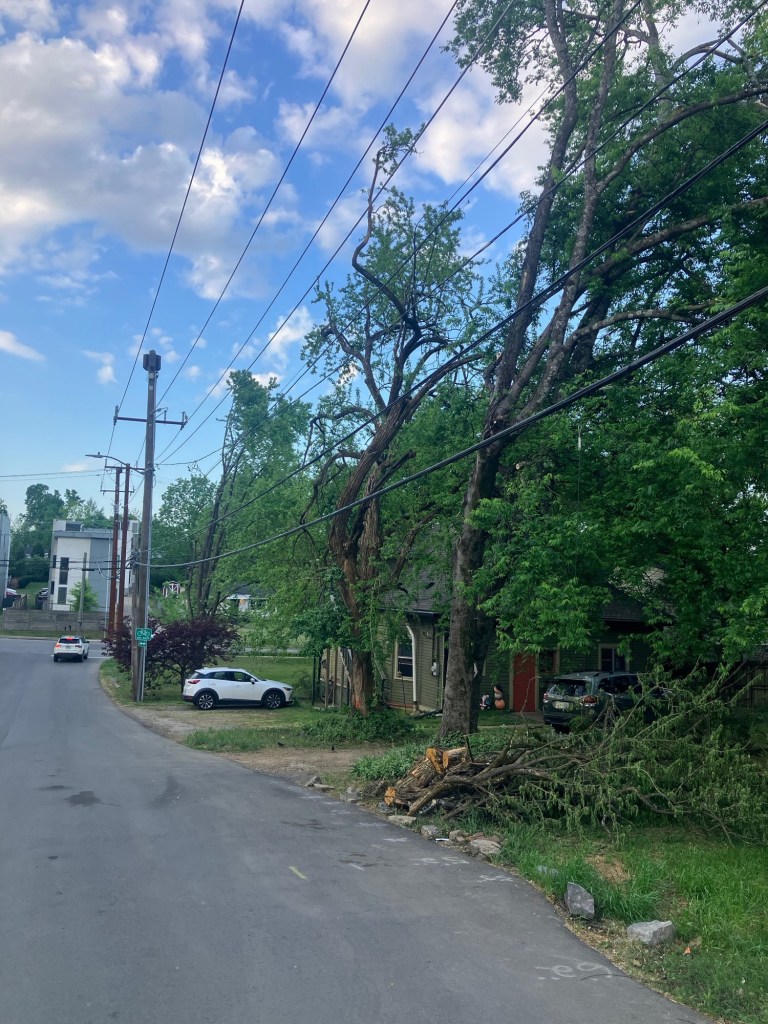
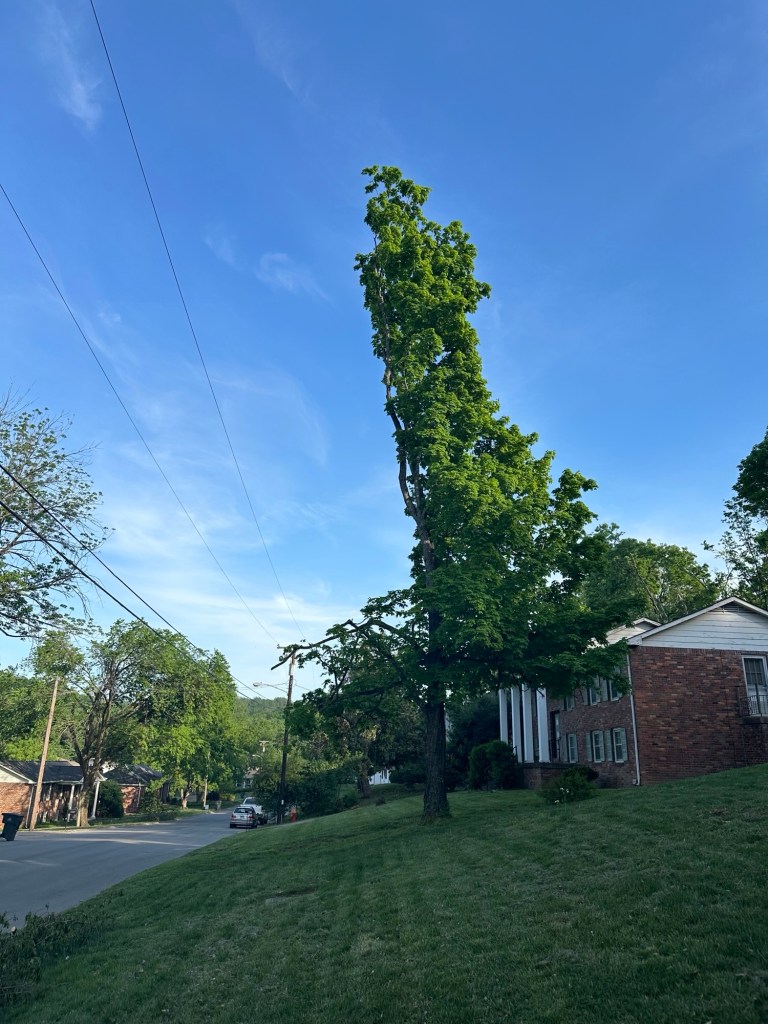
Today’s Sidewalk Nature: new trimming guidelines from NES (Nashville Electric Service). I’m naming this particular technique “Soil to Sky.” What happens to a tree when a “side prune” removes half the total leaf volume: an entire side from soil to sky? What happens when cuts are made in spring, right before the heat of summer? How can a tree feed itself and try to compartmentalize the wounds? How can it survive?
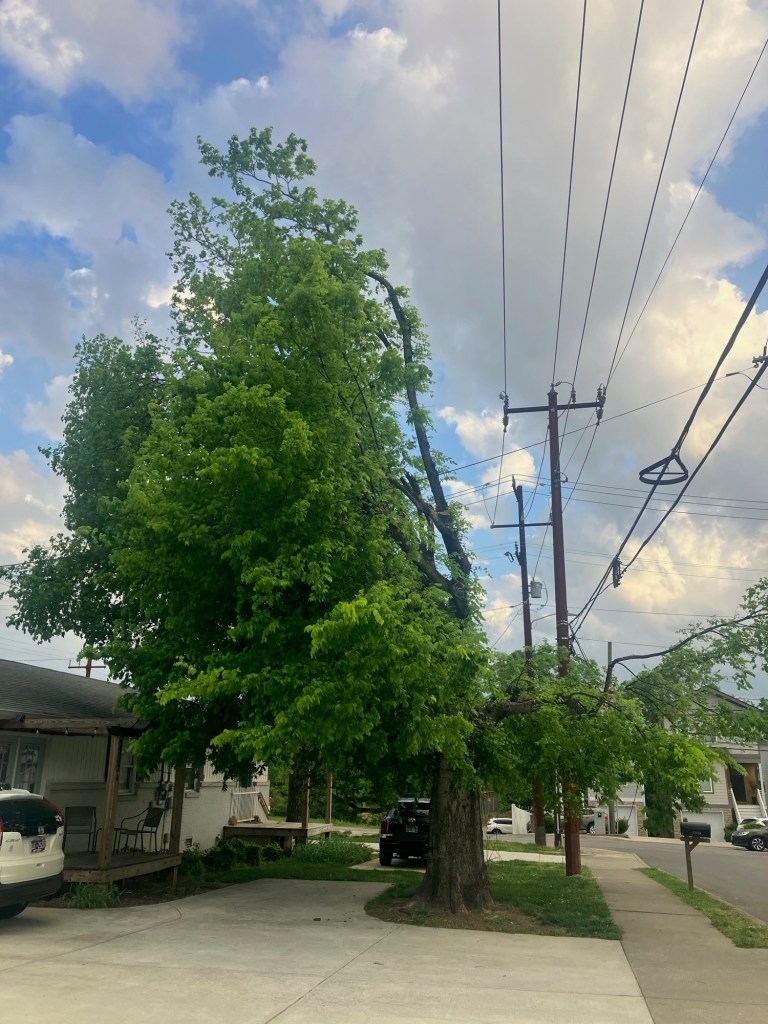
Street trees are already stressed by virtue of being street trees, bless them. They battle soil compression, air pollution, light pollution, lawn chemicals, weed-eaters, and more than their fair share of dog pee, while every root is tucked under turfgrass, concrete, or asphalt.
(NB: all photos in this post are local and from this past week.)
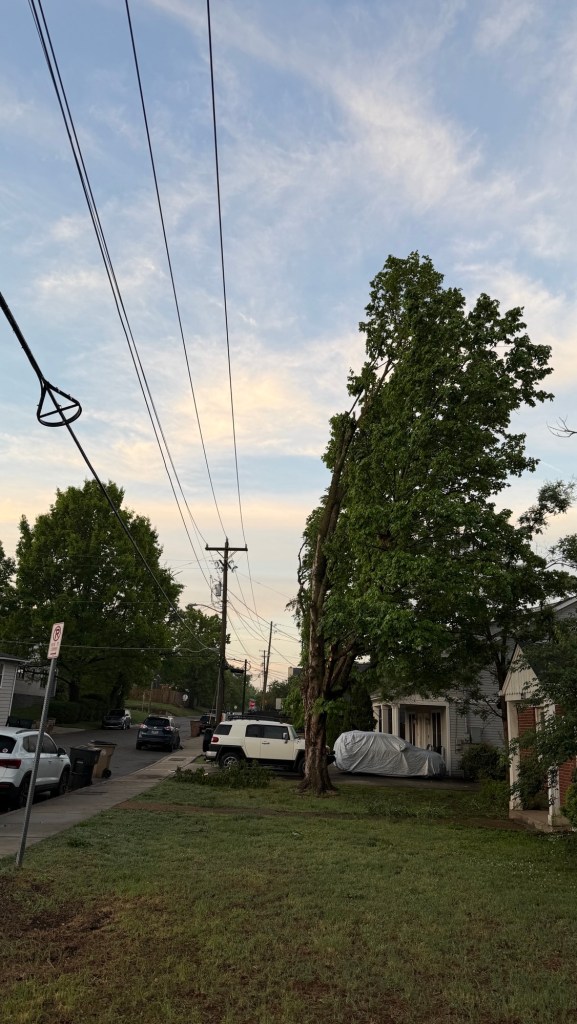
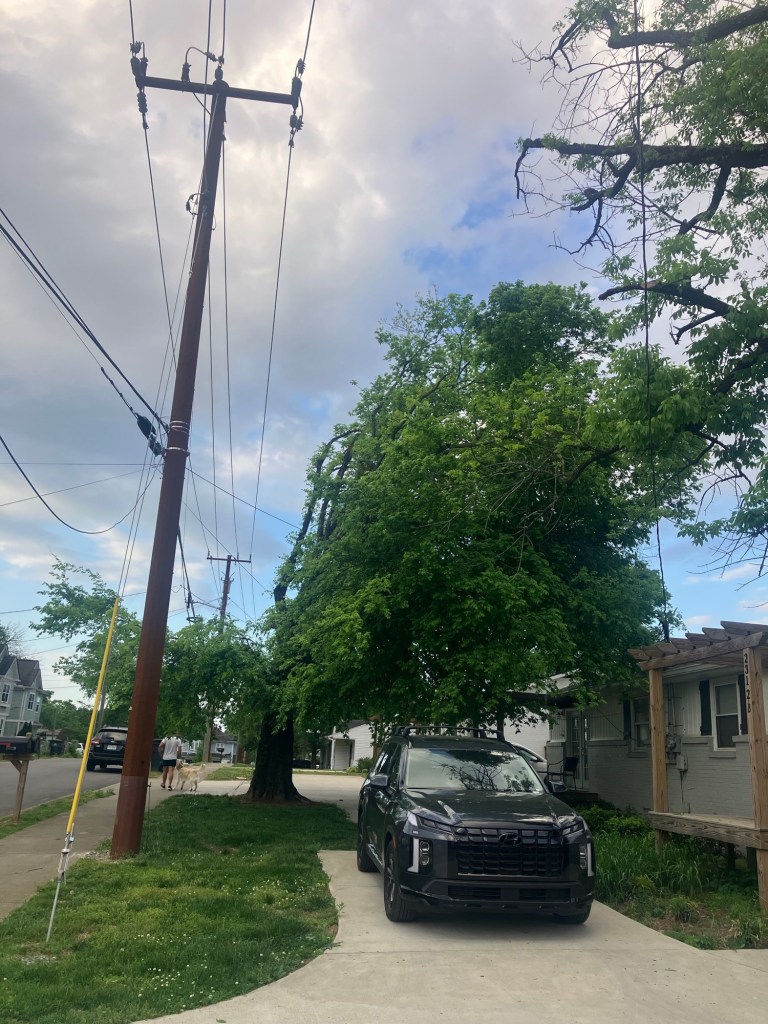
Another new guideline is removal if a tree grows within 15 feet of a powerline. Until ice-storm Fern, the distance was 10 feet. Now: “Trees growing directly under or within 15 feet of power lines can be difficult to trim. In some cases, it is best to remove the tree. Candidates for tree removal are assessed on an individual basis.”
While this extension may sound reasonable, it doesn’t look reasonable on the sidewalks of my neighborhood, where most of our street trees are within those 15 feet. Many are big, fat, glorious, old shade trees. If they go, all that native biomass goes, along with the hundreds of butterfly and moth species who rely on those leaves for their caterpillars (tiger swallowtail, luna moth, etc.) and the 96% of local birds who rely on those caterpillars as baby food to raise young right this minute.
Also gone are the leaves that regulate temperature and
make oxygen
absorb carbon dioxide
clean the air
intercept stormwater
make shade
store carbon
feed the foodweb
create habitat
reduce crime
increase property value
boost human health.
THE BIRDS
This is nesting season. Birds are raising chicks in branches, in cavities, in and under shrubs. Even common bird species are in decline, so why pick spring as the season for city-wide tree trimming? It’s against Federal law to remove an active nest—a nest with eggs and/or young—but will tree trimmers inspect every branch and hole to be sure it is free of robins or bluebirds or, in this case, of a family of Eastern screech owls in a sidewalk sugarberry?
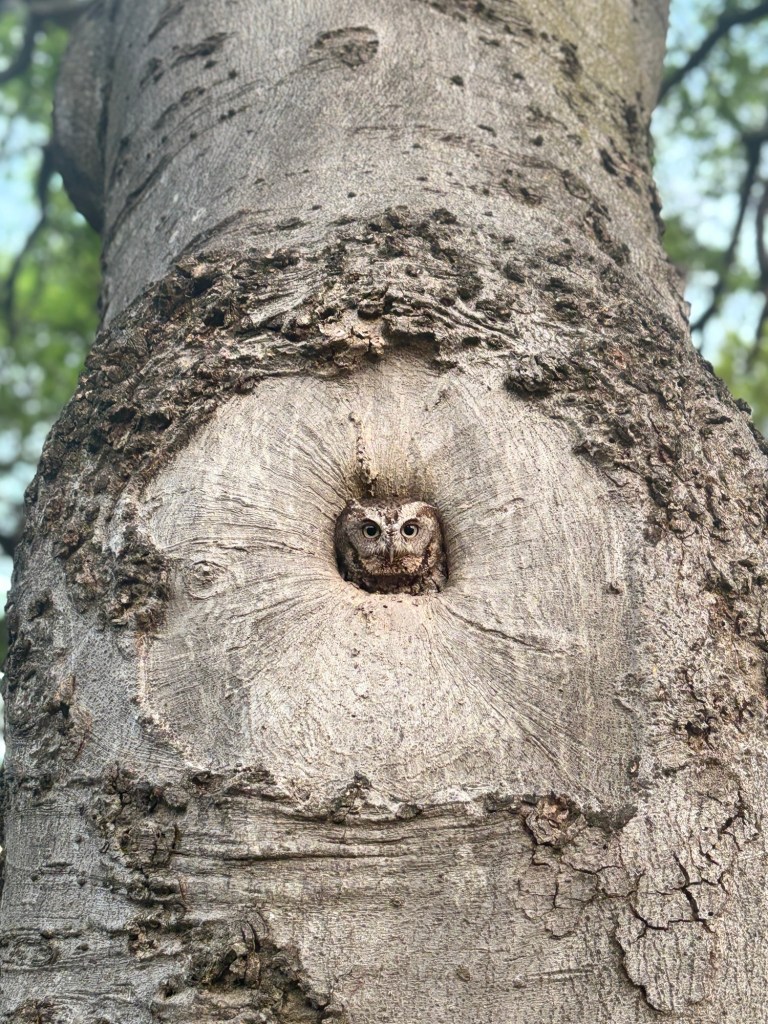
A local bird expert told me that birds here are finished breeding in July.
Can the trimming be bumped until August?
Nashville is an official “Bird Safe” city, and city-wide, drastic tree-trimming in spring is not safe for birds.
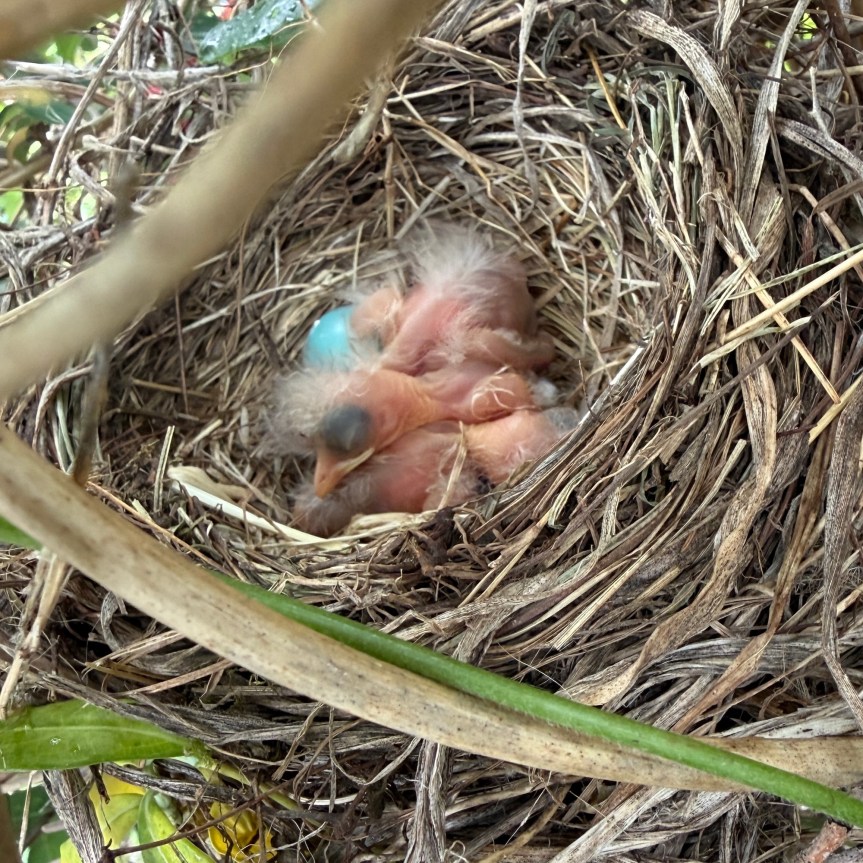
WHAT TO DO
Share concerns with local councilmembers, members-at-large, and Metro Beautification and Environment commissioners. Share photos if you have them, and be sure the damage was done by NES.
Share concerns and questions with NES, and when they text or email to say they’ll be trimming nearby, ask for a meeting with a supervisor. A friend is leaving a note on her trees asking politely for what she prefers. Meetings and notes may make a difference. Remember, “Candidates for tree removal are assessed on an individual basis.”
Also, find out if your favorite local tree and nature organizations are already involved in talks with NES, and if they are, support them, and if they aren’t, invite them to be. It wouldn’t hurt to show your support on their socials: you never know who might see a comment and join in.
THE LAW
NES has the right to trim or remove ANY tree in the right-of-way and beyond, so be polite. The law is on their side. (See note below for quote.) Powerline safety is important, but until someone figures out a way to bury the lines, we will be negotiating on a tree by tree basis for a long time. Sometimes the solution is clear cut, literally, but sometimes there will be room for negotiation.
Rumor has it that NES’s new guidelines are an “overcompensation” for ice-storm Fern, and are perhaps a “CYA” situation. (I had to google CYA, which means “cover your ass.”) This may be true, but their goals are powerline safety and human safety. We need to remember that NES line workers risked their lives to restore power after the devastation, and that they’d prefer to prevent similar scenarios.
I am grateful for safe powerlines, but I question the arboricultural practices of “Soil to Sky,”
of cutting limbs without leaving branch collars necessary for growing “wound wood” and compartmentalizing damage,
of cutting down trees that sailed through the ice storm and recent winds without damage,
cutting down every tree within 15 feet of a line,
and cutting during nesting season.
Basically, I’m worried about the health of our trees, our birds, and our city. Is there room for negotiation about how to keep powerlines safe and how to avoid removing or pruning-to-death the majority of street trees? What rights might property-owners have?
I’m hoping that Metro Stormwater, Metro Urban Forestry and other local tree, bird, and nature organizations can advocate for trees and birds so that we can save drastic measures for situations that truly warrant it.
PLANTING FOR NES (and nests)
My next post will be “Power(line) Planting,” about adding native shrubs and trees to bring back biodiversity, while staying within NES guidelines.
Links / Notes:
– Nashville Electric Service’s post-Fern tree trimming guidelines, link.
*“Courts in Tennessee support a public utility’s right to trim and remove trees, both within and outside of the right-of-way. According to the Municipal Electric Plant Law of 1935 and the Metro Charter, Appendix III, Article 42, NES has the power to purchase, construct, maintain and improve the electric system and to “do all acts and things necessary and convenient” to carry out the power given.” Quote is from the NES page linked above.
-“Bird Losses Aren’t Just Declining, They’re Declining Faster, New Study Says,” New York Times, January 2026, link.
-“State of the Birds” report 2025, North American Bird Conservation Initiative, link
More
SidewalkNature:
-Subscribe to Sidewalk Nature to get an email when I update. I never share your info.
-Follow on Instagram or Facebook, where posts are 100% nature.
SUBSCRIBE
-General comment or question? Click Contact.
-Corrections, suggestions, new friends always welcome.
Bio:
Joanna Brichetto is a naturalist and writer in Nashville. Her book, This is How a Robin Drinks: Essays on Urban Nature, is an almanac of 52 true stories about the world “under our feet, over our heads, and beside us; the very places we need to know first.” Called “Nashville’s Sidewalk Naturalist,” Jo hopes to meet all her plant and animal neighbors, and to help human neighbors add native habitat where we live, work, and play.
She’s at work on her second book, “Hackberry Appreciation Society,” and you can find her at SidewalkNature.com (“Everyday wonders in everyday habitat loss”) and on Instagram @Jo_Brichetto.
 SIDEWALK NATURE