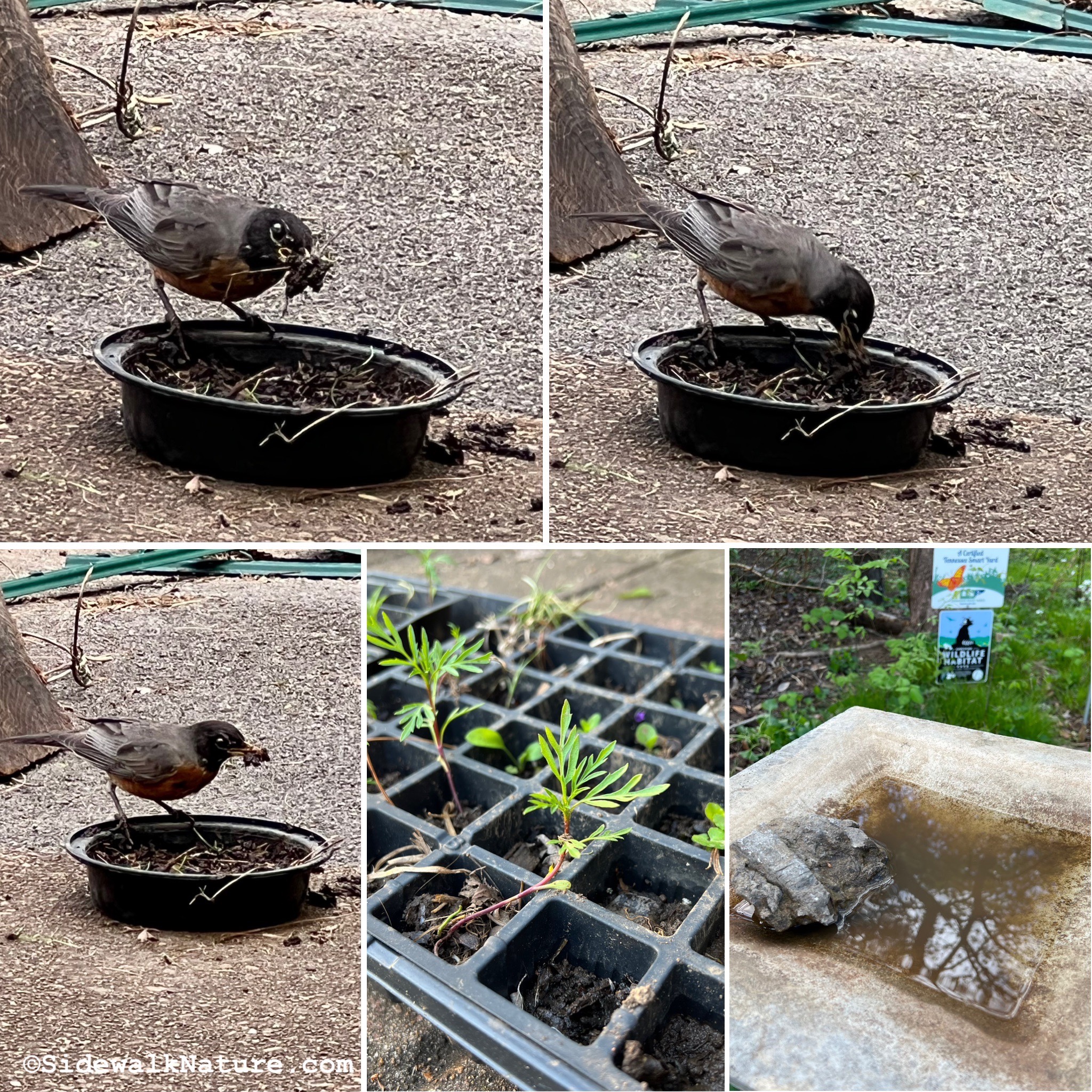
I caught a Robin Redbreast red-handed: she was taking soil from a tray on the porch. She took my seedlings, too, but only to toss them aside. She was treating my lovingly planted seedtray as her personal mudpile. Robins need wet soil to make their nests.
Most yards nearby are solid turfgrass with no soil in sight, but even my yard’s bare patches aren’t useful to her: they are compressed with our walking, and cracked with no rain.
So I sat on the porch and watched the tray. She came, she stole, she flew across the street.
Then I hid the tray under my chair. A moment later, the Robin was under my chair, too.
Every March, Nashville Mustard shines from old lawns at a handful of Metro Parks. The plant is a true Nashville native: an endemic wildflower that only happens in a few counties. And when it happens in blankets of bright yellow, it is glorious. It’s a Nashville Superbloom.
And then every March, the mowers come. I worry if the plants had time to set enough seeds to make a blanket the next year, and the next.
[flattened, hairy, round seedpods/silicles]
Nashville Mustard (Paysonia lescurii) is sort of a secret. Who’s heard of it? And why should we care? You can’t even buy it, because no nursery anywhere sells the plants or the seeds.
I vote we make it a Thing. A Good Nashville Thing. It could be nonpartisan PR that anyone could celebrate. At the very least, it could be an annual Social Media Superbloom Photo-op. And a reason to learn why “native matters.” Nashville Mustard is a piece of old Nashville: really old, like when the buffalo roamed.
Much of our part of Tennessee was grassland, where “the combination of grazing, browsing, and trampling by large herbivores maintained short stature grasslands in which endemic plants such as … Paysonia … evolved.”*
Buffalo were the first mowers of Nashville Mustard, but our lawnmowers may the be last.
Today’s Backyard Nature: the Butterfly who gives caterpillars a bad name. This is a Cabbage White, a species from Europe who aims for leaves in the Cabbage / Mustard family. In this blurry pic, she is laying an egg on annual Honesty, an exotic mustard. See her abdomen curving up to place an egg under the leaf? The hatchling will be one of the dreaded, green caterpillars called “cabbage worms.”
When I talk to people about “caterpillar host plants,” and then these people say they HATE caterpillars, THIS particular caterpillar is usually why.
Many gardeners who grow kale, cabbage, arugula, brussels, etc. learn to hate these caterpillars. And by association, learn to hate all caterpillars. And then, to reach for the pesticide.
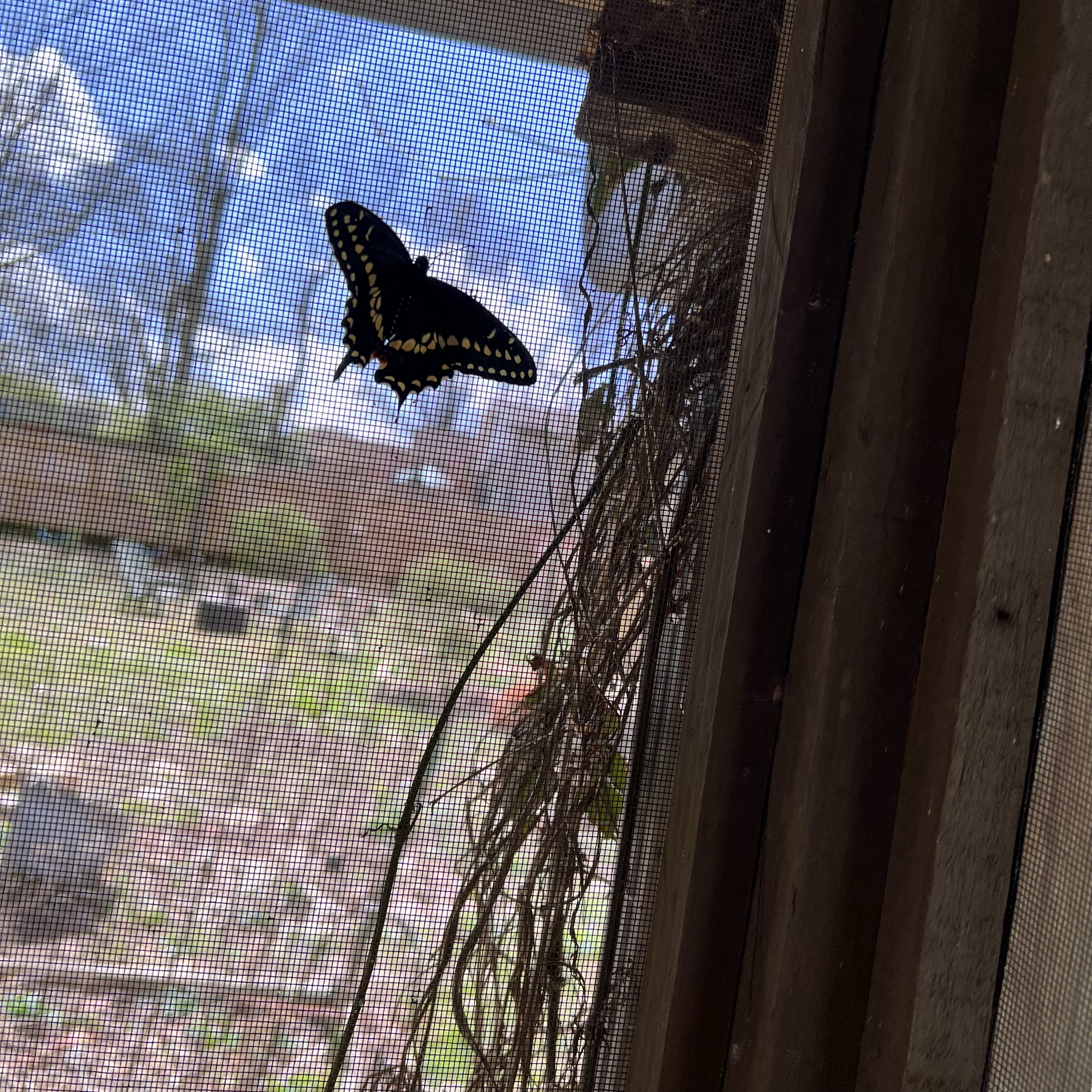
Today’s Back Porch Nature: a surprise Swallowtail! It was fluttering inside the Southwest corner of our screened porch, trying to get out. I have no idea where the chrysalis was hidden all winter, but it was somewhere among my Show ‘n’ Tell twigs and leaves and seeds and nests and other treasures. If the porch was tidier, I’d probably find the telltale meconium stain from when the butterfly eclosed this morning.
Black Swallowtail, male. If he was female, he’d have less yellow on top, but more blue. I put him in a butterfly cage just long enough to show him to my family, and to get a picture for ID.
I usually use the ol’ Monarch butterfly example to talk to beginners about “host” plants and “specialization,” which can illustrate “Why Native Matters.”
But right now, in lucky lawns all over town, there buzzes another great example: the Spring Beauty bee.
Monarchs can’t raise babies on anything but Milkweed, right? Well, Spring Beauty bees can’t raise babies without Spring Beauty pollen.
Spring Beauty is Claytonia virginica, a not-common-enough “common” wildflower in Nashville. And Spring Beauty bees are Andrena erigeniae, a native mining bee.
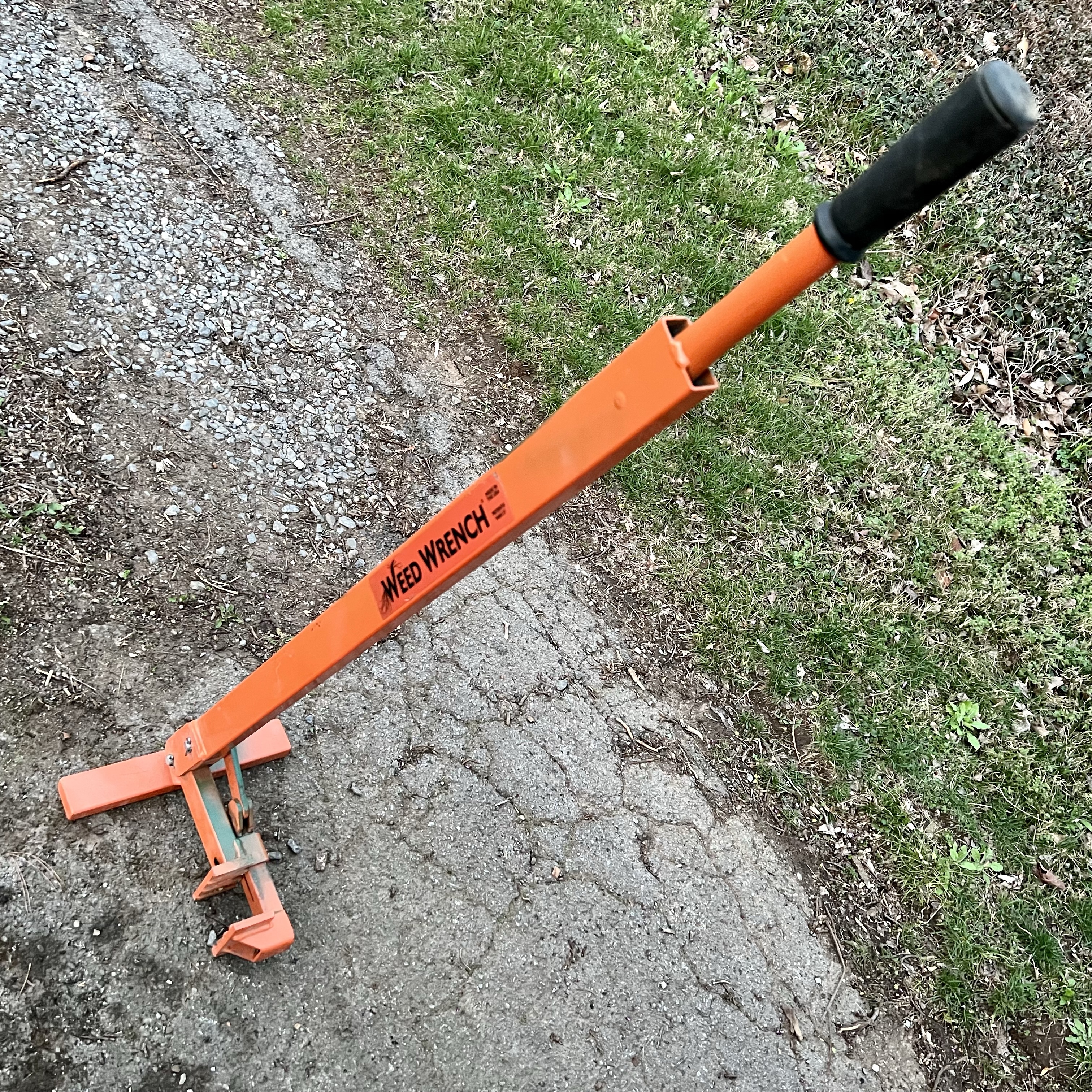
People volunteer at a WeedWrangle® for countless reasons, but one reason, I propose, is the Weed Wrench. It is more than just the Tool of Choice. It is the tool we covet; the tool that—thanks to the magic of leverage—offers the most gratification for the least effort; and the tool that gives us mild-mannered nature-lovers the rare and oh-so-welcome frisson of AUTHORIZED DESTRUCTION.
At a WeedWrangle®, we wield a Weed Wrench as AGENTS OF DEMOLITION, as ANGELS OF DOOM. We bite, rip, and kill any exotic, invasive plant that can fit inside the metal jaws of a Weed Wrench.
But, we destroy in order to serve a higher purpose: to CREATE. To bring habitat which brings back birds, butterflies, bumble bees, lightning bugs.
While recovering from migraine during freakishly warm February days, I pull weeds. Slowly, gently, quietly, and in the shade. So far, I have filled an entire 30 gallon Leaf Bag with nothing but one kind of weed. My worst weed. The weed I wish would die in a supernova: the Star of Bethlehem.
I’ve ranted about this plant before (here), but I rant again because on every public occasion when I point to the foliage or the flowers and proclaim the thuggery of this twinkling plant, I am met with disbelief. “Oh, but it’s so sweet!” gush the disbelievers. Sweet, pretty, adorable, etc.
All true. I used to make sweet, pretty, adorable bouquets of the flowers—all the flowers—in hopes that plucking them would prevent seed-formation, and perhaps reduce the number of new Stars next Spring.
But plucking did not work. Digging did not work. Smothering with cardboard did not work. Repeated removal of leaves did not work. Nothing works. New constellations continue to spread across the yard.
Mosquito season is here! Instead of spraying pesticides onto our entire yards—and onto fireflies, ladybugs, bumblebees, and butterflies—why not kill *only* mosquitoes?
But first: let’s PREVENT mosquitoes from breeding in our yards. Get rid of all standing water at least once a week: in plant saucers, trash cans, toys, and gutters.
(image from Florida Health)
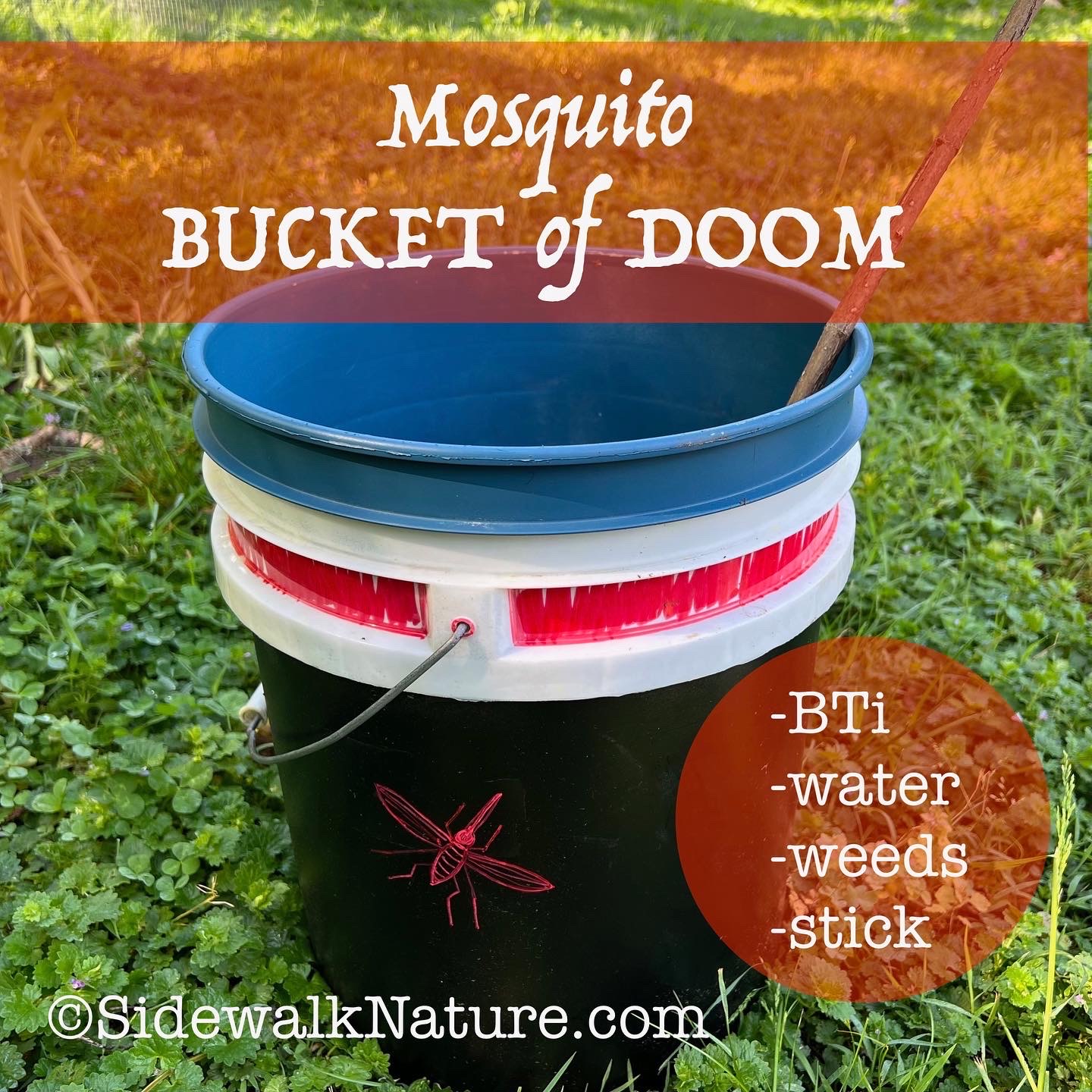
Then, let’s CREATE standing water, but only in a Mosquito Bucket of Doom. It’s a safe, cheap, easy way to control mosquitoes, and more effective than sprays and foggers.
“Are you home now??” texted my neighbor. ”I think there’s hundreds or thousands of bees making a nest in our pine tree as we speak. It’s crazy!!”
To me, it wasn’t crazy: it was perfect. Two friends had already witnessed this very thing in their yards recently, and I was jealous. So I texted back: “It’s swarm time!”
By the time I got to my neighbor’s yard, all the bees had gathered in one spot, AS one spot: one big blob of buzzing, crawling, and flying creatures, at about 30 feet up the tree. They looked like a giant dollop of bubbling goo about to drip from a branch.
A honeybee swarm!
I am grateful my neighbor knew what to do: call me, and I am grateful I knew what to tell her: call a swarm-catcher.
Today’s Front Yard Nature: an inchworm on a Black Cherry seedling. This is how nature is supposed to work: native plants = caterpillar food. No one was eating the equally tiny seedlings of exotic bush honeysuckle in the same porch crack.
My nearest mature Black Cherry tree is blocks away, but every summer, birds poop the purple-painted seeds onto the driveway, the yard and the cracks in the porch. This too, is how nature is supposed to work. I toss the exotic weeds to shrivel in the sun, but I plant some of the natives in cups to grow, or to give away, or to plant somewhere else when nobody’s watching.
Black Cherry / Prunus serotina is one of the Prunus species on the National Wildlife Federation’s native plant finder for my zipcode. The list states that it can feed 320 species of caterpillar, but right now, this particular Black Cherry is only big enough to support *one.*
more #SidewalkNature:
Follow me on Instagram, where posts are 100% nature, and most of it the Sidewalk kind.
Subscribe to Sidewalk Nature and get an email when I update. I never share your info.
Comment on this post, or if you have a general comment or question, click Contact. Corrections, suggestions, and new friends always welcome.
Bio: Joanna Brichetto is a naturalist and writer in Nashville, the hackberry-tree capital of the world. She writes about everyday marvels amid everyday habitat loss, and her essays have appeared in Creative Nonfiction, Brevity, Fourth Genre, Hippocampus, The Hopper, Flyway, The Common, Stonecrop Review, The Fourth River and other journals. Her forthcoming book is Paradise in a Parking Lot: Unlikely Stories from Urban Nature.