First Week of April: Trees

A roundup of quick Sidewalk Nature updates: one warning and three wonders.

Trouble with Double

Kwanzan cherry trees don’t feed pollinators or birds. They look great two weeks of the year but they don’t support our foodweb. Prunus serrulata ‘Kwanzan’ / ‘Kanzan.’

My concern is that when people have room to plant one tree, this is the one they’ll want. It is cultivated for pretty, and pretty it is, but it doesn’t have nectar, doesn’t make fruit, and as a nonnative congener, its leaves support only a fraction of the Lepidoptera species a native Prunus / cherry can.

But at the Cherry Blossom Festival this month, festival-goers can walk away with a free Kwanzan cherry tree from the Nashville Tree Foundation.

Continue reading “First Week of April: Trees”

Periodical Panic: Why Not To

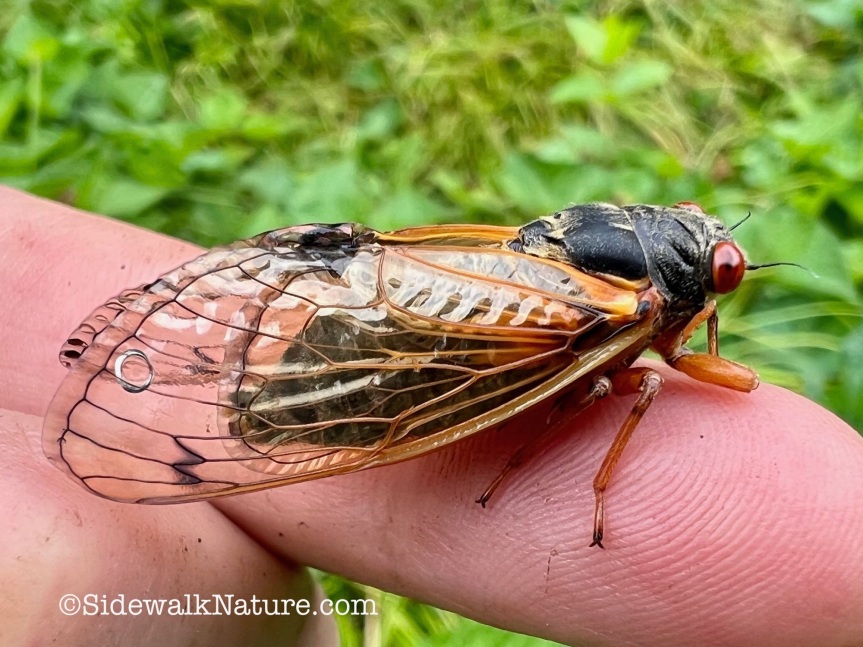
Nashville’s 13-year periodical cicadas are coming this May, but what’s already here is panic. 

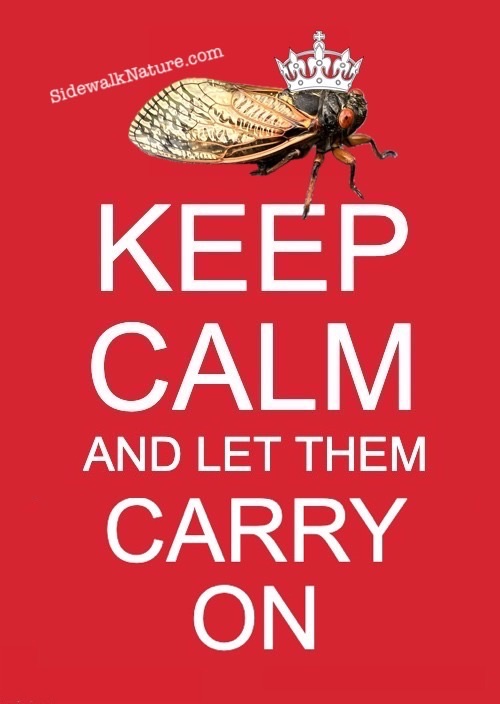
For months, worried people have been asking about the 2024 “invasion.” Should they cover their trees? Should they wait to plant new trees? Should they reschedule outdoor events, and even indoor events? Will there be “too many” cicadas? No. The answer to all these questions is “no.” 

3 reasons not to panic about “too many” cicadas:

Continue reading “Periodical Panic: Why Not To”

Secret Sidewalk: eight late-November wonders

As fall drifts toward winter, nature doesn’t slow down, not really. Amazing things happen all around us, all the time. This site’s tagline: “Everyday wonders in everyday habitat loss” includes not just “natural” areas, but our own yards, trash alleys, parking lots, roadsides. For example, our Secret Sidewalk …

The Secret Sidewalk is a shortcut through 3 neighborhood blocks, but rather than running along a street, it runs between homes. It’s a 5-foot-wide Metro right-of-way flanked by property lines, and it feels intimate, despite crossing four roads, and despite tall privacy fences. It takes walkers past a mix of cultivated and wild. Exotics, natives, volunteers, invasives: all here. Signs of the season change daily.

Continue reading “Secret Sidewalk: eight late-November wonders”

What a Robin Sees (Spring edition)

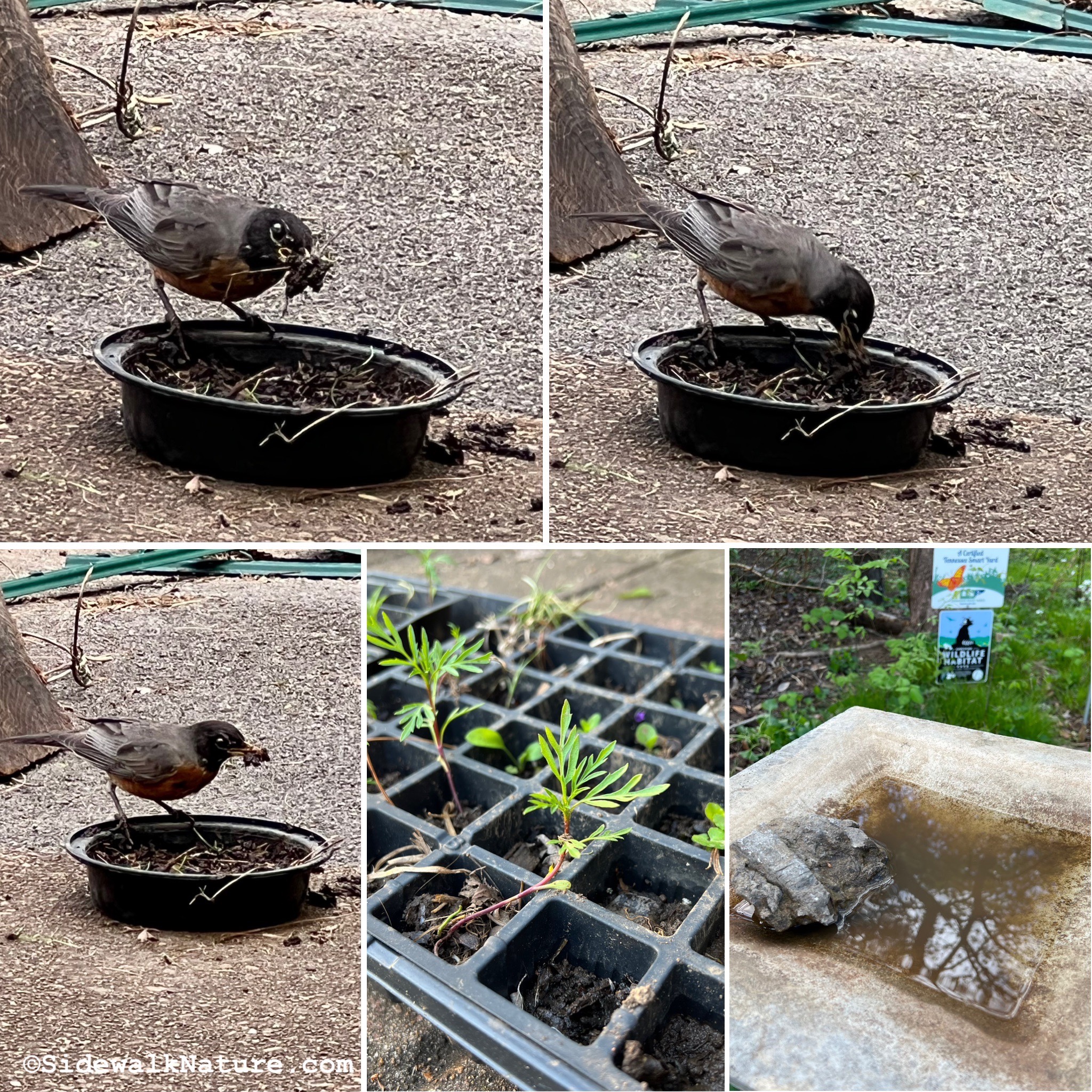
I caught a Robin Redbreast red-handed: she was taking soil from a tray on the porch. She took my seedlings, too, but only to toss them aside. She was treating my lovingly planted seedtray as her personal mudpile. Robins need wet soil to make their nests. 

Most yards nearby are solid turfgrass with no soil in sight, but even my yard’s bare patches aren’t useful to her: they are compressed with our walking, and cracked with no rain. 

So I sat on the porch and watched the tray.
She came, she stole, she flew across the street. 

Then I hid the tray under my chair. A moment later, the Robin was under my chair, too.

Continue reading “What a Robin Sees (Spring edition)”

Cutting the Mustard

Every March, Nashville Mustard shines from old lawns at a handful of Metro Parks. The plant is a true Nashville native: an endemic wildflower that only happens in a few counties. And when it happens in blankets of bright yellow, it is glorious. It’s a Nashville Superbloom.

And then every March, the mowers come.
I worry if the plants had time to set enough seeds to make a blanket the next year, and the next.

[flattened, hairy, round seedpods/silicles]

Nashville Mustard (Paysonia lescurii) is sort of a secret. Who’s heard of it? And why should we care? You can’t even buy it, because no nursery anywhere sells the plants or the seeds.

I vote we make it a Thing. A Good Nashville Thing. It could be nonpartisan PR that anyone could celebrate.
At the very least, it could be an annual Social Media Superbloom Photo-op. And a reason to learn why “native matters.” Nashville Mustard is a piece of old Nashville: really old, like when the buffalo roamed.

Much of our part of Tennessee was grassland, where “the combination of grazing, browsing, and trampling by large herbivores maintained short stature grasslands in which endemic plants such as … Paysonia … evolved.”*

Buffalo were the first mowers of Nashville Mustard, but our lawnmowers may the be last.

Continue reading “Cutting the Mustard”

Spring Beauties: Bee + Bloom

[Spring Beauty bee]

I usually use the ol’ Monarch butterfly example to talk to beginners about “host” plants and “specialization,” which can illustrate “Why Native Matters.”

But right now, in lucky lawns all over town, there buzzes another great example: the Spring Beauty bee.

Monarchs can’t raise babies on anything but Milkweed, right?
Well, Spring Beauty bees can’t raise babies without Spring Beauty pollen.

Spring Beauty is Claytonia virginica, a not-common-enough “common” wildflower in Nashville.
And Spring Beauty bees are Andrena erigeniae, a native mining bee.

Continue reading “Spring Beauties: Bee + Bloom”

Who Eats Kousa Dogwood?

exotic fruit nobody eats

(A Cautionary Tale in Second Person)

Here’s what you wonder:
if Kousa (Japanese) dogwoods evolved in East Asia with wildlife there, what eats Kousa fruit here?

Because you already know that Nashville butterflies and moths can’t use Kousa leaves as caterpillar food.

And because you now suspect that the fruit piling up under neighborhood Kousa trees will keep piling up, uneaten.
The fruits looks like round, warty raspberries but with long, cherry stems.

So, you watch and learn that:
*squirrels ignore them,
and
*birds ignore them.

So, you ask the Internet and learn that:
*monkeys were the main disperser in the native range,
and
*people can also eat the fruit.

Continue reading “Who Eats Kousa Dogwood?”

Native Puzzler

I saw the puzzle at a used book sale. My kids are old, I am old, I don’t work at a school anymore, but I really, really wanted that preschool puzzle.

First, I showed it to my Middle Schooler. “Please tell me not to buy this gorgeous puzzle from 1975.” 

“Put it back,” he said, putting it back.

Then, I texted a photo to my friend Taunia, and added the same (disingenuous) demand: “Please tell me not to buy this gorgeous puzzle from 1975.”

And Taunia answered, “How could you NOT!?” Continue reading “Native Puzzler”

Red-shouldered bugs and a fresh assassin

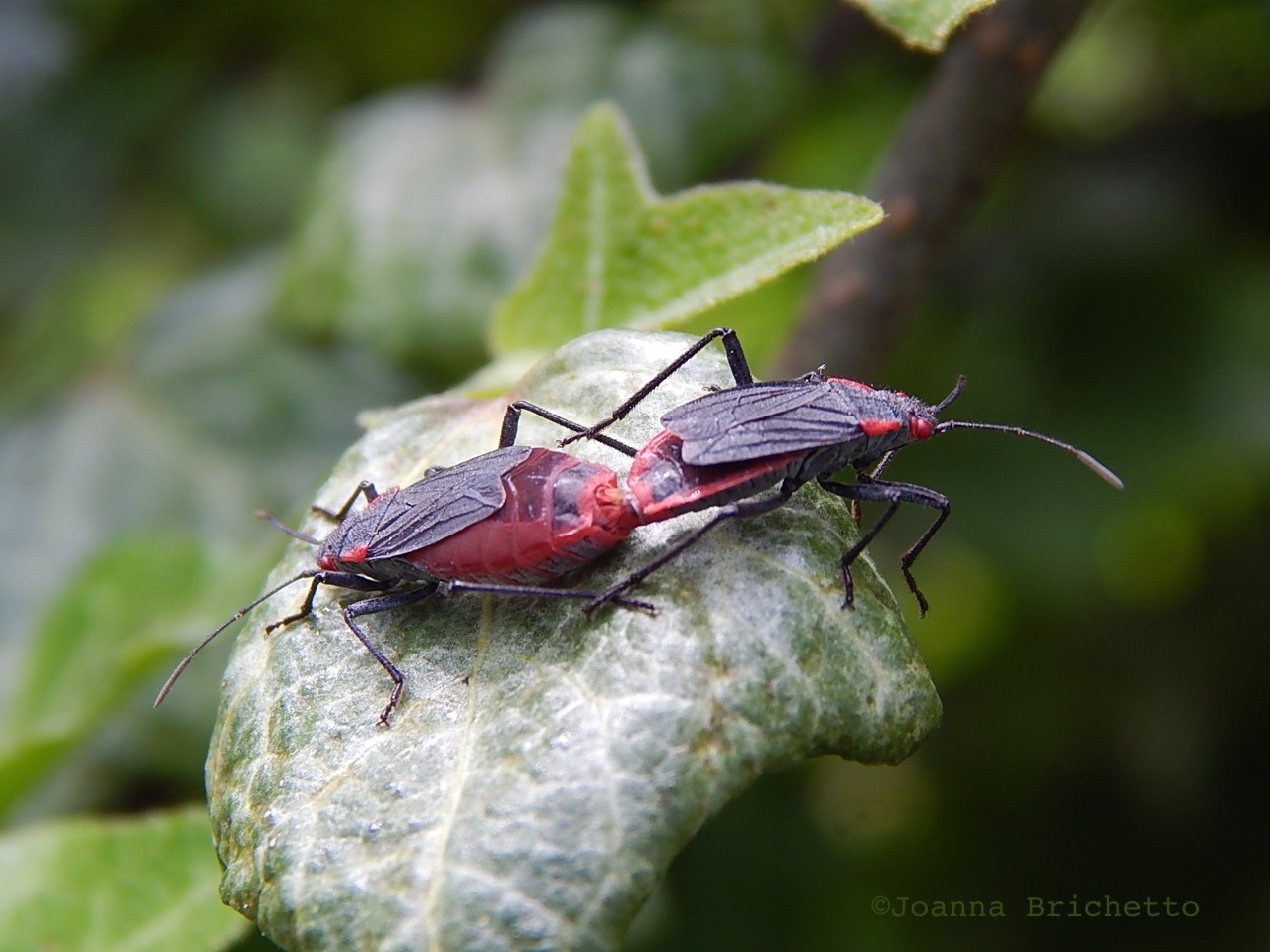
red shouldered bugs

I knew they weren’t box-elder bugs, but what? Hundreds and hundreds were mating and scurrying about on a (stupid) bush honeysuckle covered with (stupid) English ivy. So I type “red shoulder bug,” into BugGuide and guess what they are?
“Red-shouldered Bugs.” Continue reading “Red-shouldered bugs and a fresh assassin”