Cicada update: babies

Look who hatched today! The first baby of Brood XIX periodical cicadas! With lots of luck, this new nymph will survive the next 13 years underground, then emerge and molt into adulthood in May 2037. Right now, it is barely bigger than the egg it came from, but you can see six legs, two antennae, and cute little eyes. 

Part of that luck starts with the egg itself. If eggs are deposited in a twig that snaps, browns, and hangs (“flagging”) or in a twig that breaks onto sunny lawn, the eggs are not likely to survive. They dry out if not protected by living plant tissue. And then, at hatch time, if a nymph drops to any other surface but soil, it is doomed. And if the merest breeze wafts it to the roof, driveway, bird bath, street: doomed. And if it gets mown, trimmed, blown, sprayed w/ any pesticide: doomed. And if it gets spotted by even one of a zillion predators above-ground or below: doomed. 
Good luck, little cicada!

New nymphs will be hatching for several weeks now, so watch for falling, tiny, white creatures. I’m pinning black t-shirts to the clothesline, the better to spot the contrast. I’m also watching our dog’s black-furred back as we walk her, in case neighborhood nymphs drop on for a ride.

Continue reading “Cicada update: babies”

Periodical Panic, Part 2

Part 1 tried to calm panic about tree damage, noise, stink, inconvenience.
Part 2 will try to stir panic, but on behalf of the cicadas.

Here’s a new yard sign I wish I could sneak all over town. Even though many of us had a “No Mow April” sign, some of us need this new one, just for a few days: “No Mow Cicada.”

**Can we please delay our obsessively tidy, short-bladed, weekly mow and blows? For another week or maybe two?**

(^not a real sign, just a real digital image)

Cicada emergence is well underway, and in some areas almost over, but our lawncare is killing them before they get a chance to mate.

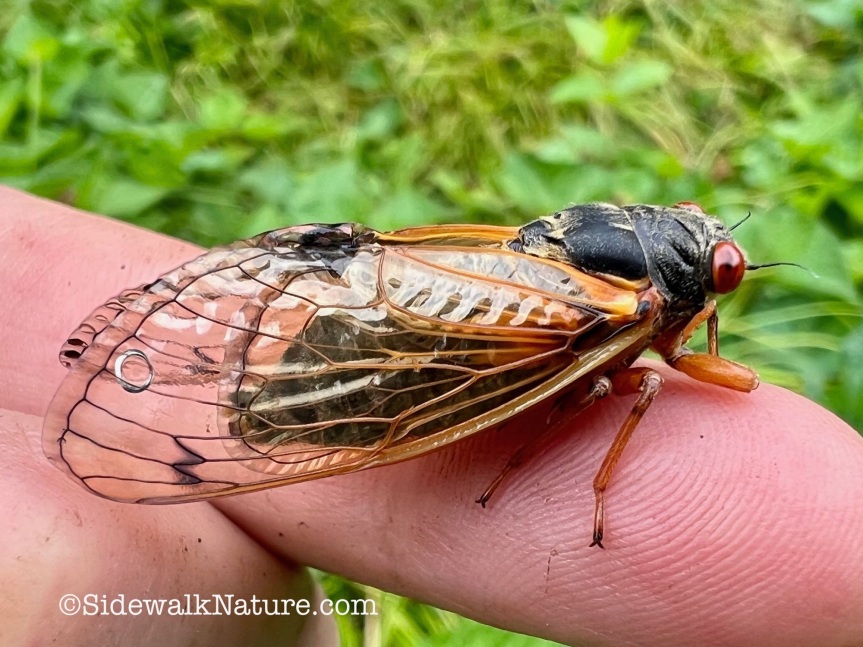
It’s all about timing. These cicadas have spent 13 years underground prepping for the moment they emerge from the soil, climb a vertical thing, hang on tight, and break out of their nymphal exoskeleton. This final transition can take hours. They start to appear at dusk, but by morning many are still searching for a safe spot, or are mid-way through their final molt, or are still hanging to let their white, dough-soft bodies sclerotize into stiff, black, flight-ready condition. New adults don’t even try to fly until the sun warms them, and sometimes not until afternoon. When startled, females drop to the ground. And all cicadas are notoriously clumsy fliers. 

So when a lawn crew arrives with lawnmowers, trimmers, leafblowers, pesticide sprayers, nearly all the newly emerged cicadas are doomed. Lawncare may be their most successful predator yet, and unlike the predators with whom cicadas evolved, a lawnmower does not reach “predator satiation.” A lawnmower never tires of eating cicadas. There is no end of cicadas that lawncare can kill.
Until there is an end of cicadas.

Continue reading “Periodical Panic, Part 2”

Periodical Panic: Why Not To

Nashville’s 13-year periodical cicadas are coming this May, but what’s already here is panic. 

For months, worried people have been asking about the 2024 “invasion.” Should they cover their trees? Should they wait to plant new trees? Should they reschedule outdoor events, and even indoor events? Will there be “too many” cicadas? No. The answer to all these questions is “no.” 

3 reasons not to panic about “too many” cicadas:

Continue reading “Periodical Panic: Why Not To”