Purple Martin “migratory roosting” is a right-now, must-see wonder in downtown Nashville.
Go see them while you can. Their nightly, massive, communal roost won’t last long, and no one — not even a Purple Martin — knows if they’ll be back next year.
Look who hatched today! The first baby of Brood XIX periodical cicadas! With lots of luck, this new nymph will survive the next 13 years underground, then emerge and molt into adulthood in May 2037. Right now, it is barely bigger than the egg it came from, but you can see six legs, two antennae, and cute little eyes.
Part of that luck starts with the egg itself. If eggs are deposited in a twig that snaps, browns, and hangs (“flagging”) or in a twig that breaks onto sunny lawn, the eggs are not likely to survive. They dry out if not protected by living plant tissue. And then, at hatch time, if a nymph drops to any other surface but soil, it is doomed. And if the merest breeze wafts it to the roof, driveway, bird bath, street: doomed. And if it gets mown, trimmed, blown, sprayed w/ any pesticide: doomed. And if it gets spotted by even one of a zillion predators above-ground or below: doomed. Good luck, little cicada!
New nymphs will be hatching for several weeks now, so watch for falling, tiny, white creatures. I’m pinning black t-shirts to the clothesline, the better to spot the contrast. I’m also watching our dog’s black-furred back as we walk her, in case neighborhood nymphs drop on for a ride.
Today’s Front Door Nature: A little clue to a big change.
I saw the tiny, black blip this morning. On the porch, by my feet. Picked it up, and knew it was the last molt of a Pipevine Swallowtail caterpillar: the old, squashed skin (and face!) that drops when a caterpillar becomes a chrysalis.
So, I looked up. And there was the chrysalis, fresh and glistening, above my head on a brick in the doorway.
But the best part was when I made my kid “look at the black blip,” and then he too, looked up. He looked to find the butterfly-in-progess who dropped it. He knew.
The wad of caterpillar skin tells a big story. It’s the story of a native plant / animal interaction, and of the astonishing specificity of a larval host plant. The host plant here is Wooly Pipevine (Aristolochia tomentosa), and it covers our porch rail. Native Pipevines are the only plants a Pipevine Swallowtail butterfly will lay eggs on because they are the only plants the caterpillars can eat. They’ve evolved together, in the habitat native to this place.
This is why I grow plants that make new butterflies. And why we knew what the blip was.
A butterfly host plant at the door means we get to see—just by taking a few steps outside—every life-cycle stage all summer. It’s an ideal Show and Tell for why native plants matter.
After I posted the Do-It-Yourself Mosquito Bucket of Doom (link), I realized two things: 1) I should have called the project a “Doom-It-Yourself,” and 2) Not everyone is excited about displaying an ugly bucket in their yard.
But, now I know that a Mosquito Bucket of Doom need not be ugly. Or even be a bucket. Nearly any water-tight, wide-mouthed container will do.
Personally, I’m fine sharing my yard with an ugly bucket that still advertises the 30 pounds of kitty litter it once contained:
Here’s what you wonder: if Kousa (Japanese) dogwoods evolved in East Asia with wildlife there, what eats Kousa fruit here?
Because you already know that Nashville butterflies and moths can’t use Kousa leaves as caterpillar food.
And because you now suspect that the fruit piling up under neighborhood Kousa trees will keep piling up, uneaten. The fruits looks like round, warty raspberries but with long, cherry stems.
So, you watch and learn that: *squirrels ignore them, and *birds ignore them.
So, you ask the Internet and learn that: *monkeys were the main disperser in the native range, and *people can also eat the fruit.
Do you hear what I hear? Cicadas: morning, noon, and (almost) night.
These are the Dog Day cicadas: the annual species who show up every year. Their little husks in the yard and their big songs in the trees are signs of high summer, and to me, of Home.
But more importantly, they are a sign that one bit of our world is working as it should.
If you don’t hear what I hear, can you go out and try? Listen for the buzzes and grindings and trills where the trees are: mature, native trees like Sugar maples, elms, red-cedars. For maximum effect, listen at dusk on a Greenway or near some woods, or under fat hackberries in a shady neighborhood, where the combined cicada volume can almost rattle your bones. We’re talking Spinal Tap “eleven.”
Every year, our neighbor’s treeless lawn proves good for something: June bugs. Hundreds of dark blurs zoom around us in bright sun, just a foot or two above the grass. They fly too fast to ID or catch, but when they land, they’ll crawl on a finger and take a ride.
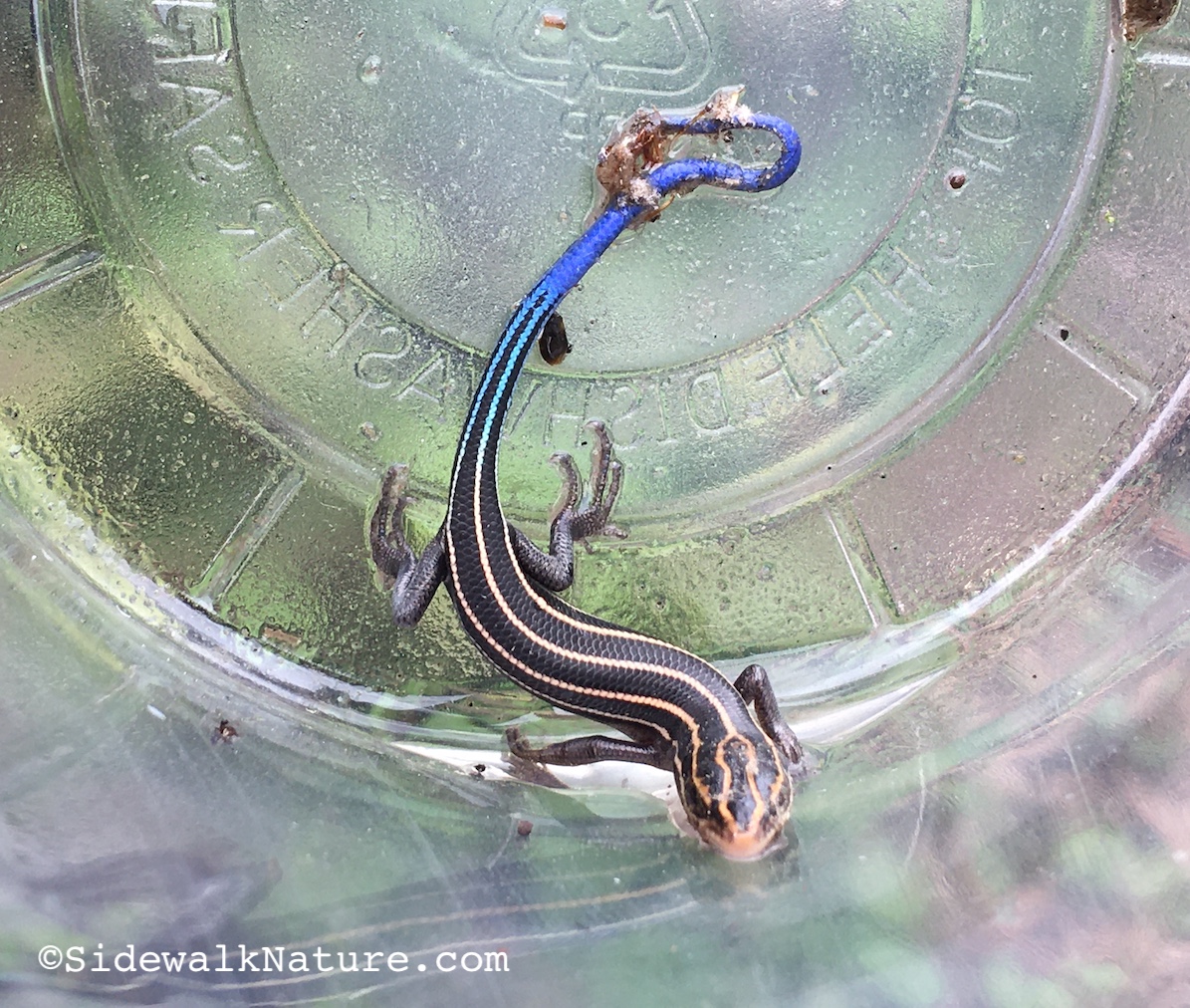
I found the first skink hanging by his tail, twisting and paddling an inch above the floor. He was caught in a spiderweb underneath a chair, and he was just a baby.
Two days later, I found another baby skink under another chair. This one was still ambulatory but slow, with legs and tail wrapped in fluffs of webbing. Both chairs sit inside my screened porch: where spiders are expected, but where skinks are not.
Skink #1, I thought, was a fluke. But after skink #2, I started looking in earnest for ways to prevent a skink #3. Because—and let me paraphrase a line from The Importance of Being Earnest:
To lose one skink to a spiderweb is unfortunate: to lose two looks like carelessness.
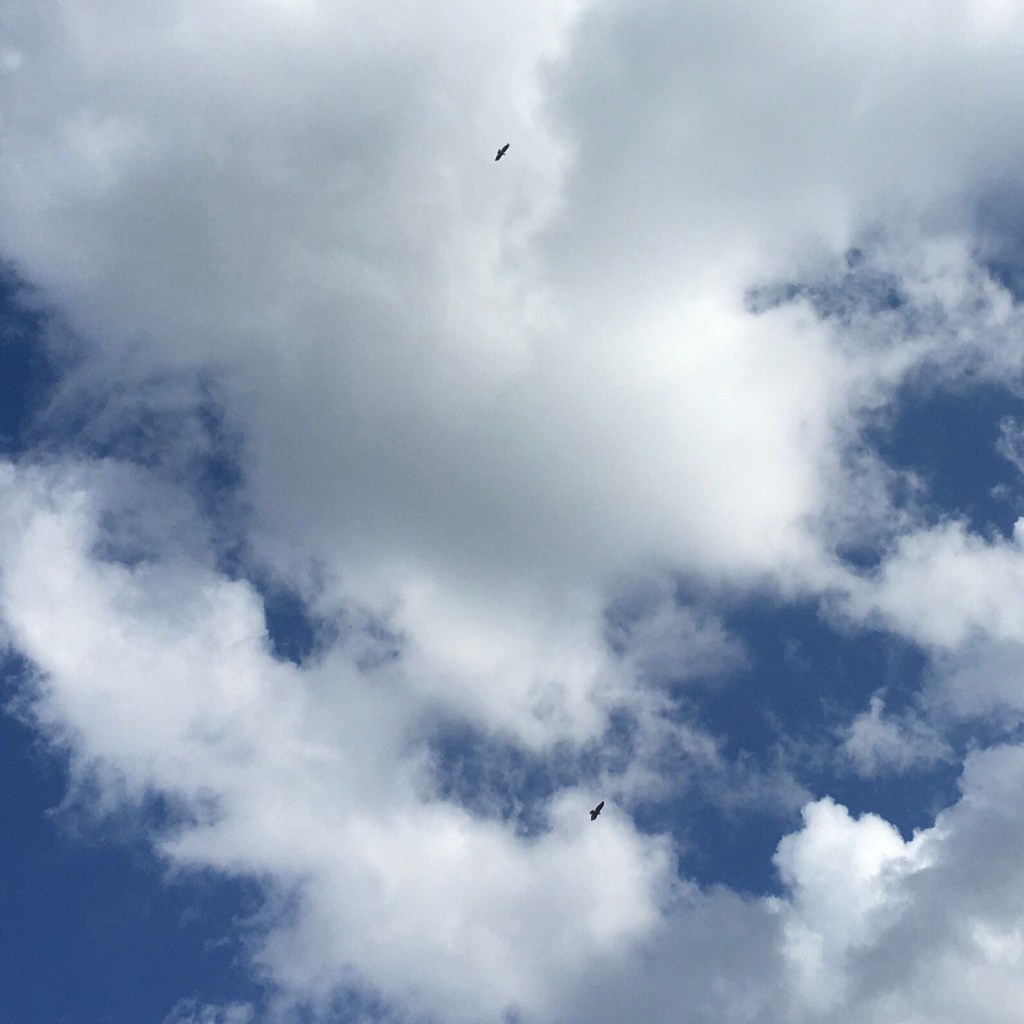
Are you hearing awkward screams lately? From the sky, I mean. These are the screams I’ve been waiting for. Awkward hawk screams are a Sign of the Season.
Every summer, the Red-tailed Hawks who hunt the neighborhood train at least one baby to hunt. And even though the baby is already the size of his parents, his call is not.
Mom and Dad do the Scary Hawk Scream familiar from movie soundtracks: the raspy but piercing KEEEEEEEEE-ARR that fills the sky for about two seconds. This, I hear year-round when Red-tails soar overhead. Here’s a quick sample:
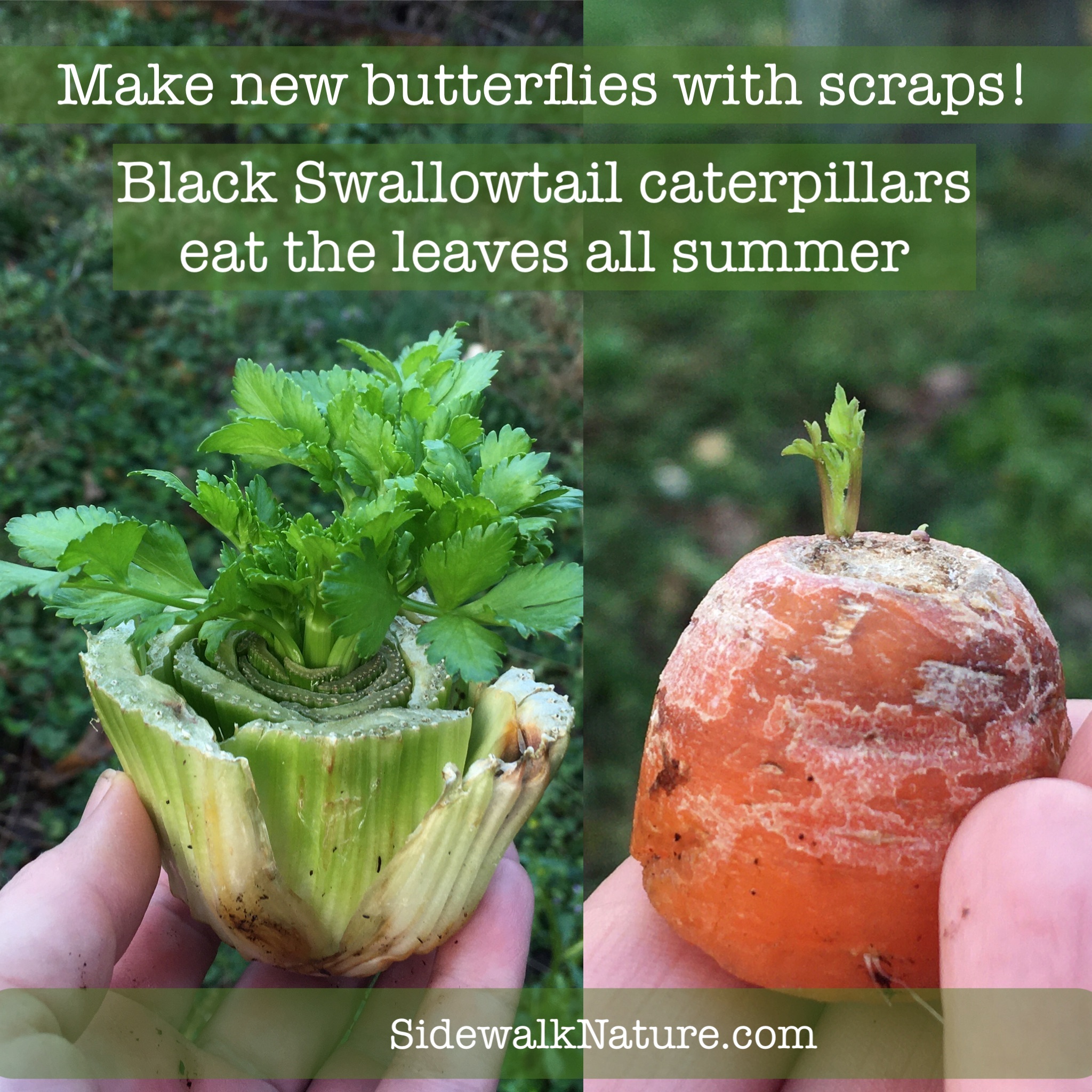
Easiest butterfly garden ever: let celery butts and carrot butts sprout, then stick ’em in soil.
Maybe I mean “easiest butterfly factory” ever, because these butts won’t just feed butterflies, they’ll make butterflies. Yes, your butt can make butterflies.
All summer, Black Swallowtail butterfly moms will find the leaves and lay eggs, and then you’ll have more Black Swallowtails. And if you put your butts where you can see them every day, you can watch the whole butterfly lifecycle from the comfort of a lawn chair.
If you have not yet watched a butterfly lay an egg, or a caterpillar hatch, or a caterpillar molt, or a caterpillar become a chrysalis, or a chrysalis become a butterfly, this scrap garden is your chance to increase your chances.
You MUST SEE THESE THINGS.
If you have a kid or a parent or a friend or soulmate or neighbor, then THEY MUST SEE THESE THINGS, TOO.



 SIDEWALK NATURE