Black Cherry Inchworm

Today’s Front Yard Nature: an inchworm on a Black Cherry seedling.
This is how nature is supposed to work: native plants = caterpillar food.
No one was eating the equally tiny seedlings of exotic bush honeysuckle in the same porch crack.

My nearest mature Black Cherry tree is blocks away, but every summer, birds poop the purple-painted seeds onto the driveway, the yard and the cracks in the porch. This too, is how nature is supposed to work.
I toss the exotic weeds to shrivel in the sun, but I plant some of the natives in cups to grow, or to give away, or to plant somewhere else when nobody’s watching.

Black Cherry / Prunus serotina is one of the Prunus species on the National Wildlife Federation’s native plant finder for my zipcode. The list states that it can feed 320 species of caterpillar, but right now, this particular Black Cherry is only big enough to support *one.*


more
#SidewalkNature:

Follow me on Instagram, where posts are 100% nature, and most of it the Sidewalk kind.

Subscribe to Sidewalk Nature and get an email when I update. I never share your info.

SUBSCRIBE:

For people who aren’t on Instagram, I post nature things on Facebook from time to time.

Comment on this post, or if you have a general comment or question, click Contact.
Corrections, suggestions, and new friends always welcome.

Bio:
Joanna Brichetto is a naturalist and writer in Nashville, the hackberry-tree capital of the world.
She writes about everyday marvels amid everyday habitat loss, and her essays have appeared in Creative NonfictionBrevity, Fourth Genre, Hippocampus, The Hopper, Flyway, The Common, Stonecrop Review, The Fourth River and other journals. Her forthcoming book is Paradise in a Parking Lot: Unlikely Stories from Urban Nature.

What White Tree is Blooming Now

My short, personal essay “What White Tree is Blooming Now” from 2018 has just been archived online, thanks to The Hopper, an environmental literary magazine. And the timing could not be more perfect…

Here’s the first bit, to test if you’d like to read more:

It started. The procession of trees. The trees don’t move, but the white does: white tree blossoms, from species to species.
First, in late February and if not charred by sleet, come white flowers of star magnolia.
Stinky Bradford pears are next, trees so ubiquitous in corporate landscapes (and invasive in natural ones) that when they froth white, even people who don’t notice trees notice.
Then, dogwood. Everyone loves dogwood.
Serviceberry, hawthorn, black cherry, yellowwood, black locust, and so on, week by week of the rolling spring, one white tree bloom after the other. It won’t stop till summer, and by then, who is watching? By then, Nashville is a weedy jungle and we stay inside to escape the chiggers. 

But I’ll be watching. The procession is important. There are rules: only white, only trees, and only where I can see them while I go about my business.

Continue reading “What White Tree is Blooming Now”

Dogwood Winter / Dogwood Spring

I’m calling it. Dogwoods are in full bloom, but this morning dawned a surprising 42 degrees—parka weather for me—so I’m calling today a Dogwood Winter.

Dogwood winter is one of the “Little Winters” of olde tyme: one of the cold spells that snuck back to bite us (and our crops) when we thought cold spells were over.

Continue reading “Dogwood Winter / Dogwood Spring”

Cast not your Pearl [Crescent] before swine

This Pearl Crescent is one reason why my To-Do list never graduates to Done. I’ll start a task—hanging laundry, pulling weeds, etc.—and then I’ll see a “bug.” 

Full stop. Nothing else matters but a sudden, urgent need to know:

Who they are, 
Why they are here, 
What they need.  

Continue reading “Cast not your Pearl [Crescent] before swine”

Instant Butterfly Garden (from scraps)

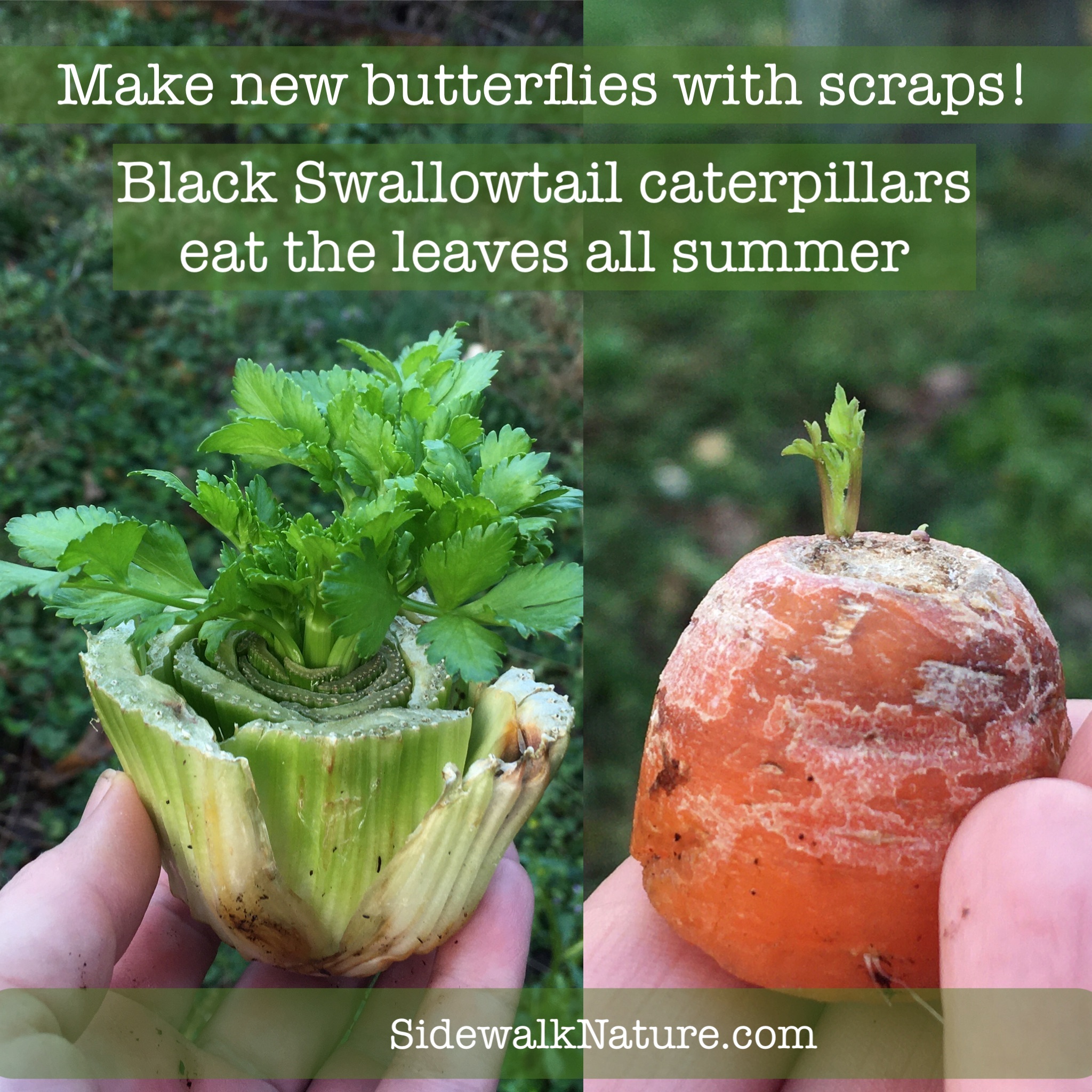
Easiest butterfly garden ever: let celery butts and carrot butts sprout, then stick ’em in soil.

Maybe I mean “easiest butterfly factory” ever, because these butts won’t just feed butterflies, they’ll make butterflies. Yes, your butt can make butterflies.

All summer, Black Swallowtail butterfly moms will find the leaves and lay eggs, and then you’ll have more Black Swallowtails.
And if you put your butts where you can see them every day, you can watch the whole butterfly lifecycle from the comfort of a lawn chair.

If you have not yet watched a butterfly lay an egg,
or a caterpillar hatch,
or a caterpillar molt,
or a caterpillar become a chrysalis,
or a chrysalis become a butterfly,
this scrap garden is your chance to increase your chances.

You MUST SEE THESE THINGS.

If you have a kid or a parent or a friend or soulmate or neighbor, then THEY MUST SEE THESE THINGS, TOO.

Continue reading “Instant Butterfly Garden (from scraps)”