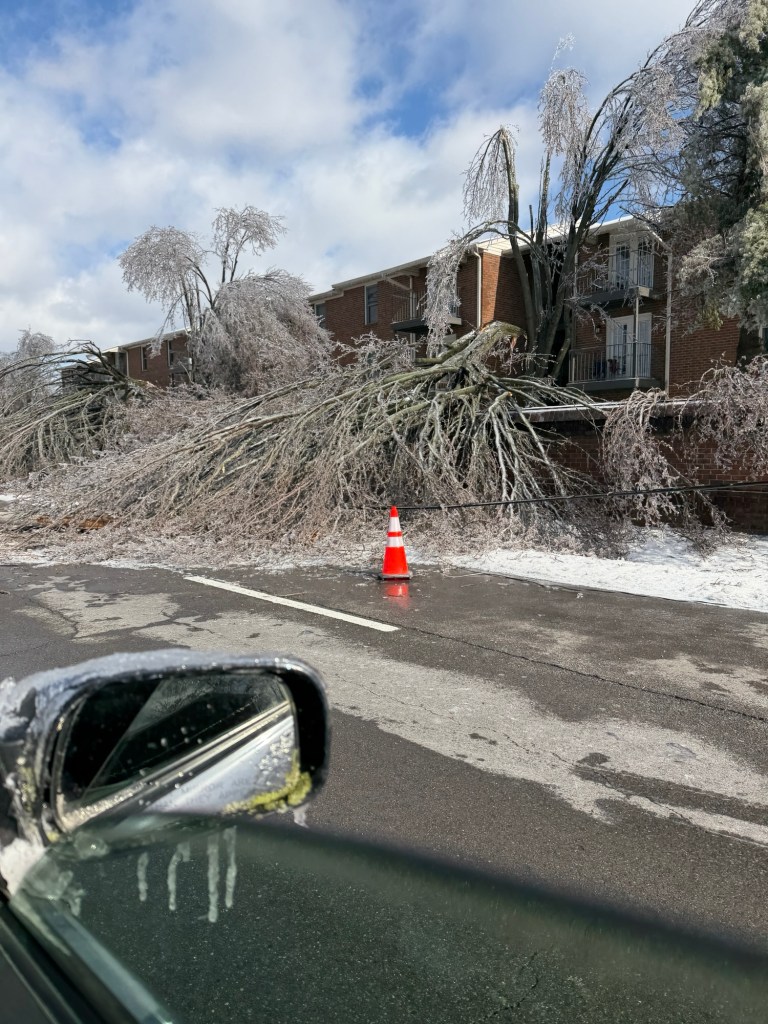
Trees are down all over town, while tree trash is piling up. A mountain of brush is already on a curb near you, and there’s more to come. So now’s the time to steal it, keep it, use it.
Do not let 100% of that lovely biomass go straight to the chipper.
Trees are life, but dead trees are life, too.
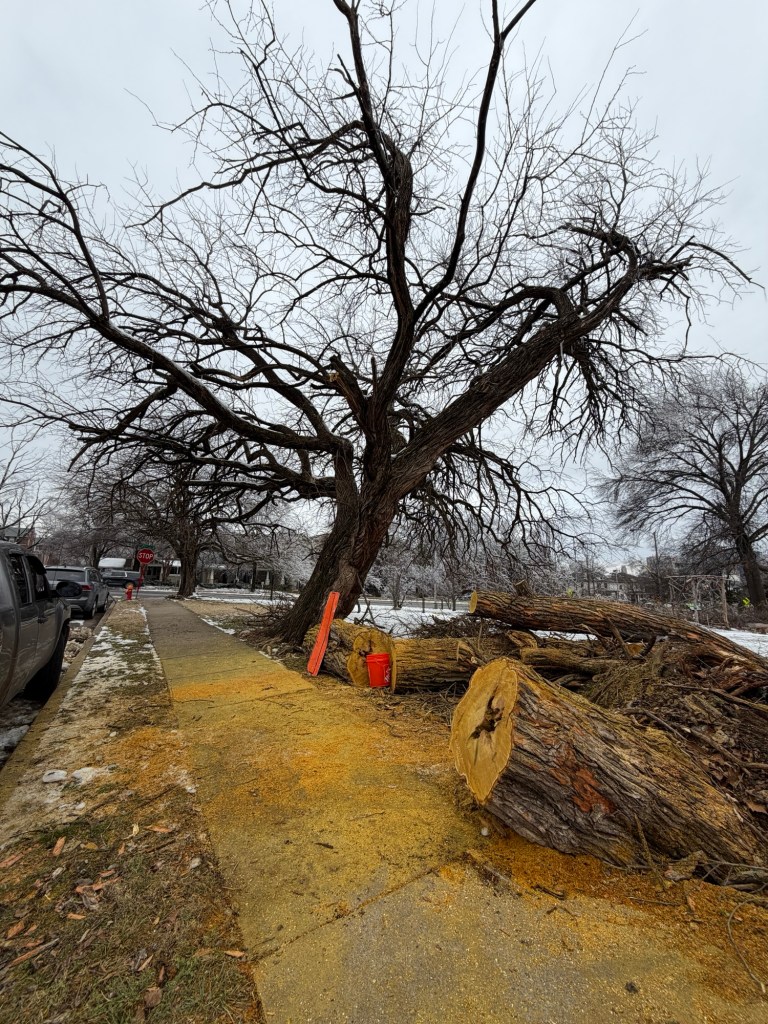
We can repurpose the carnage in so many ways, and each one can make a difference in habitat quality and soil health and climate resistance and all the other Good Things that keep us alive. And it’s all for freeeeeee!
The National Wildlife Federation says “…the removal of dead material from forests can mean a loss of habitat for up to one-fifth of the animals in the ecosystem.”
Our yards are ecosystems too, and all of them need help.
We need trees, alive *and* dead.
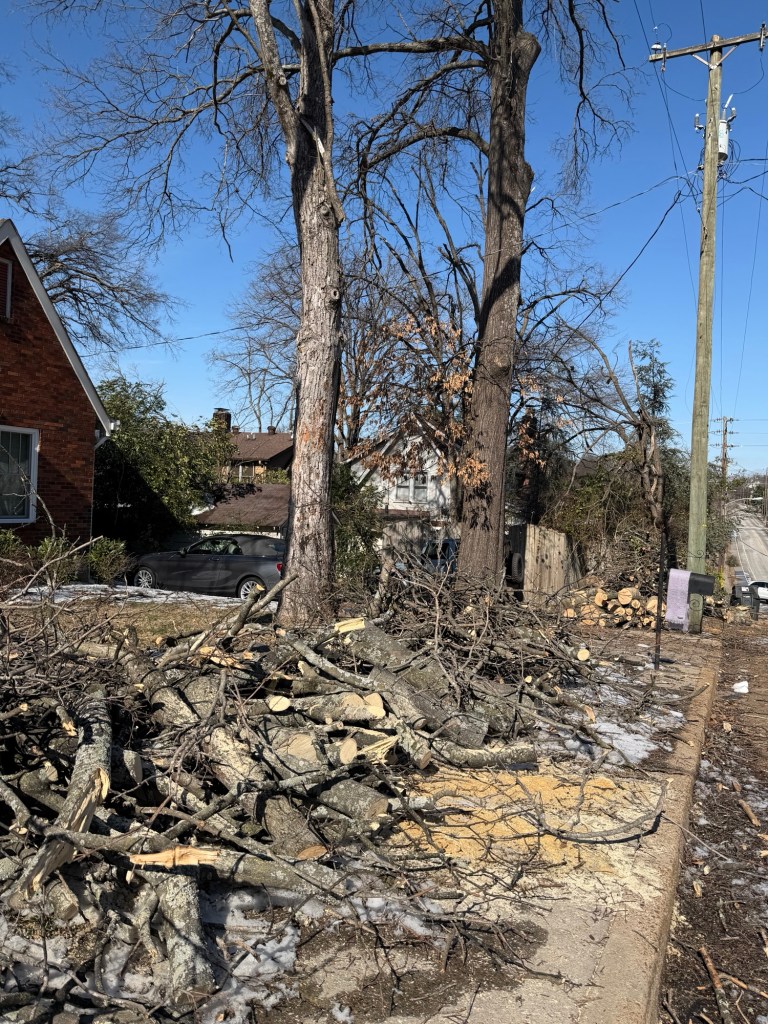
Snag
Ideally, a damaged tree here and there can be left in place as standing snags for wildlife. A snag is a bold choice, but it can work, depending on the species and the site. Our Metro parks do this when the tree isn’t over a trail or a structure (safety first!).
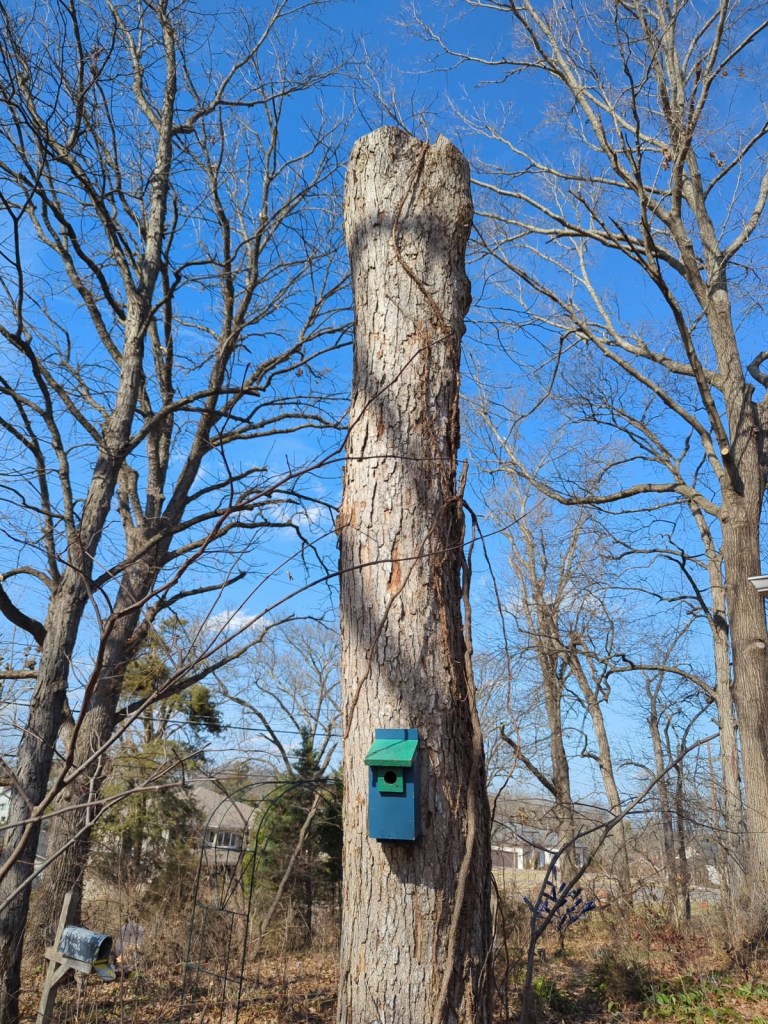
In suburban and urban settings we may need to take off some height, but a good arborist can give guidance.
Remember, ‘Capability’ Brown dotted his landscapes with dead and dying trees just for looks. We’re doing it for nature. Not only for woodpeckers and other cavity nesters, but for all of us.
Stump
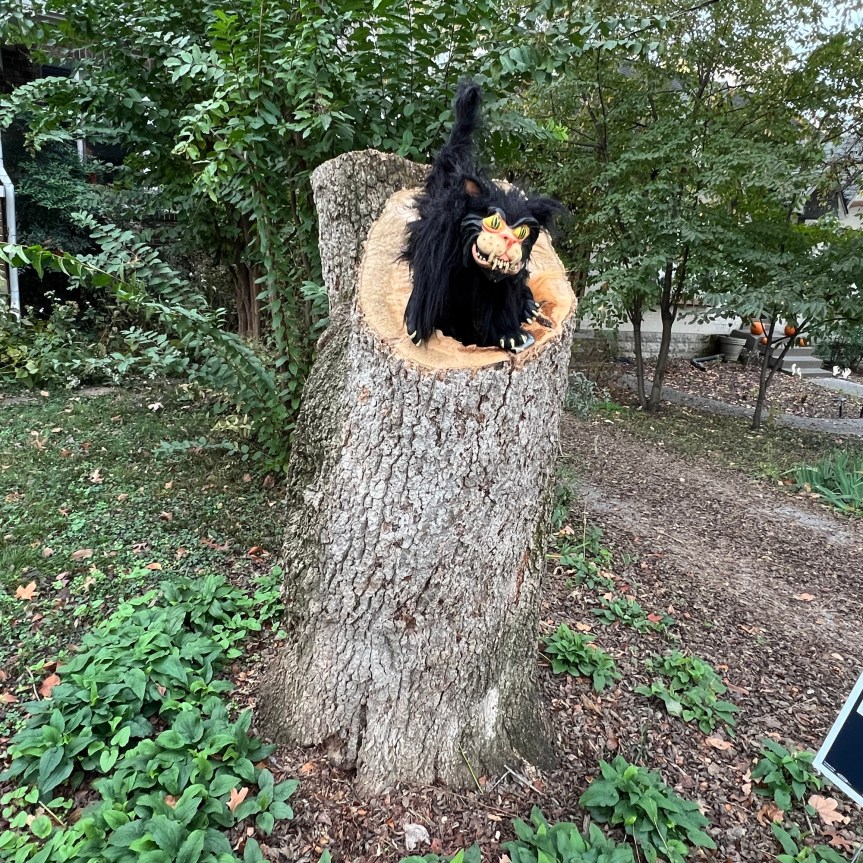
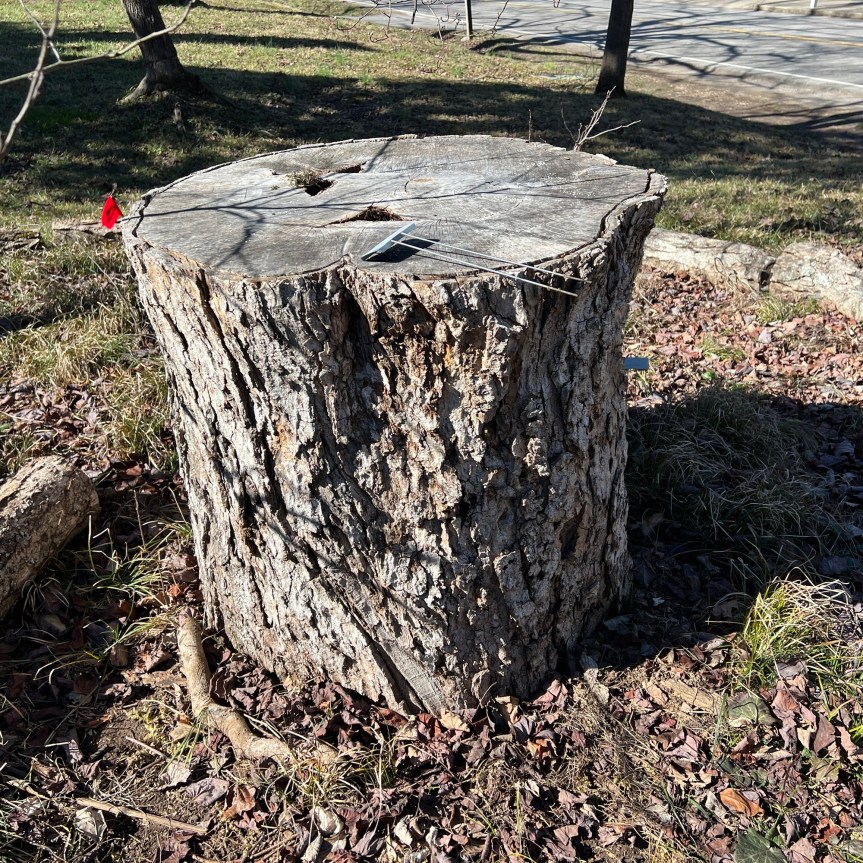
If a tree has to come down, let the stump stay up.
Fireflies can make new fireflies, skinks can make new skinks, mason bees can make new mason bees, and birds can find food.
A stump can also be a planter once the middle softens, or right away if the heart-wood is missing.
Bonus: a stump means you don’t have to pay someone to grind it.

Log
Meanwhile, logs – upright or sideways – can edge a property or a bed. “Pretty” logs can stand alone in a garden bed as a design element or a base for a birdbath.
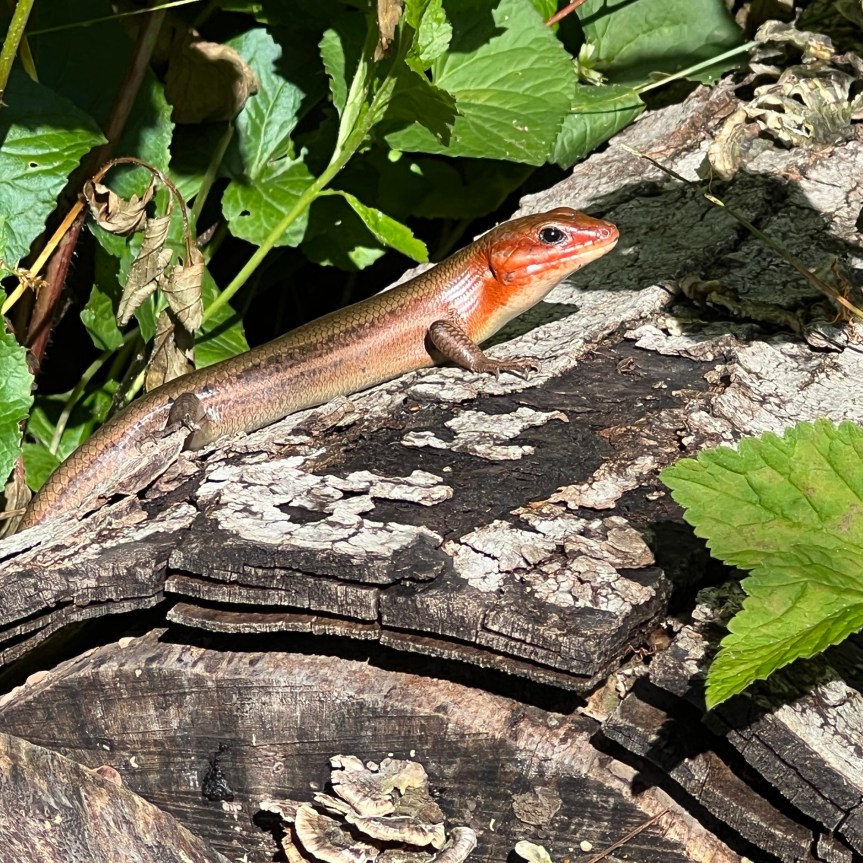
A log makes an irresistible basking spot for skinks and butterflies (not at the same time); a bench for birds and squirrels; and habitat for tiny creatures inside and underneath.
All dead wood enriches the soil.
Branch
Fallen branches can edge walkways and beds …
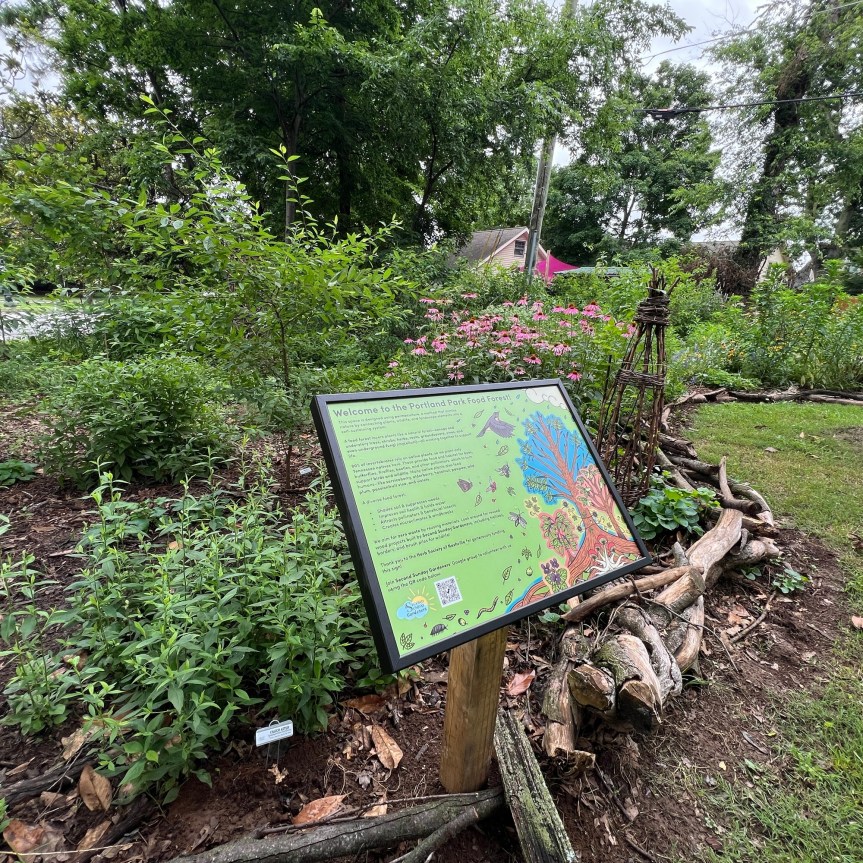
… or get sliced into matching mini-stumps arranged in a row.
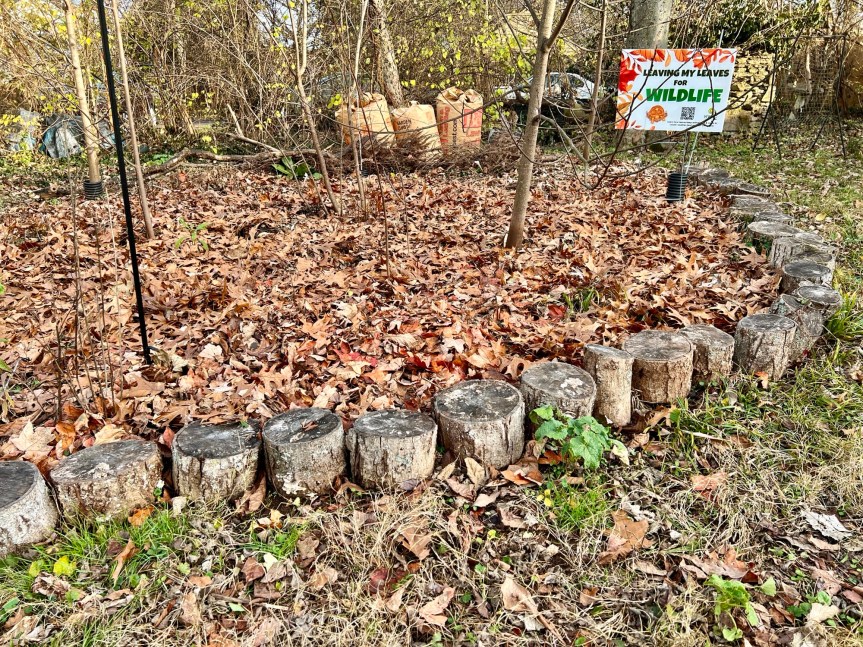
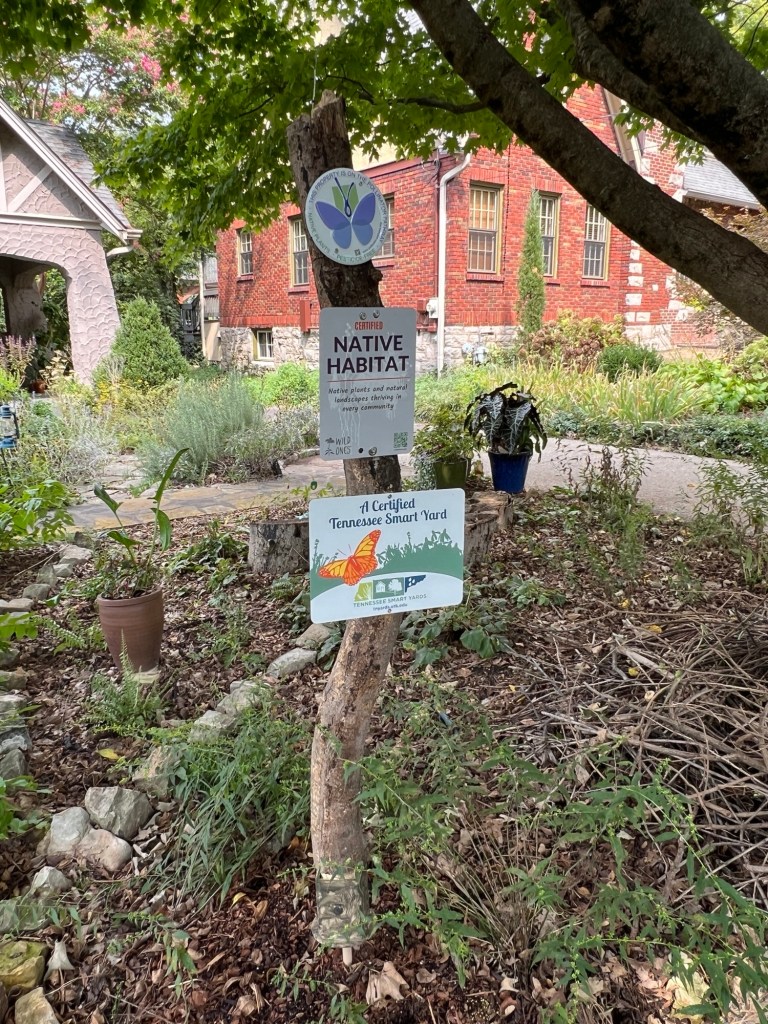
Or, a branch can hold up signs to tell neighbors what your yard is trying to do:
Brush
Smaller branches can be sandwiched between two rows of uprights to make a “dead hedge,” a privacy screen, a compost corral, a trellis.
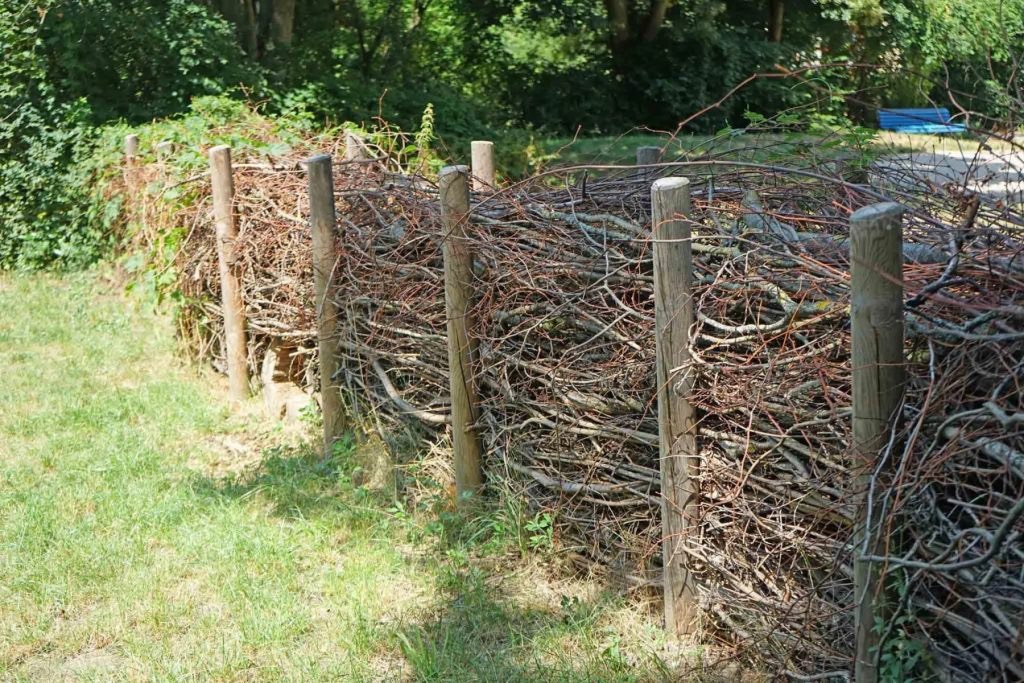
Much easier is a brush-pile tossed in a corner away from the house. A brush pile means one less place to mow, and one more place where small creatures can find shelter, food, nesting materials, or a spot to raise young.
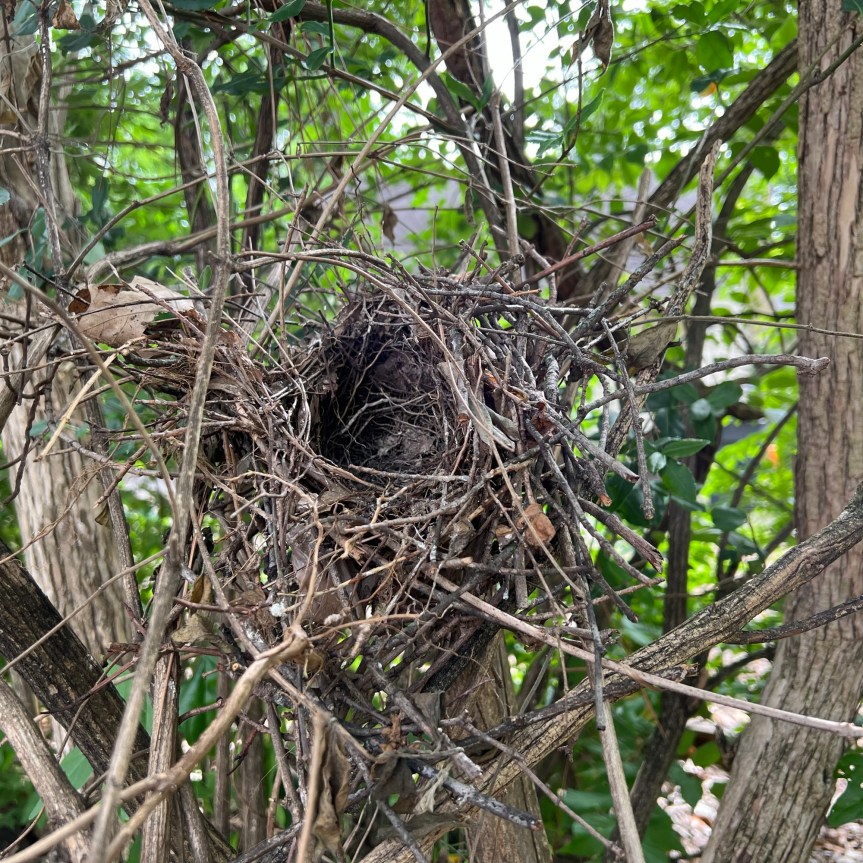
Even a few small, brushy branches poked into a flower bed can support gangly perennials next spring.
Structure
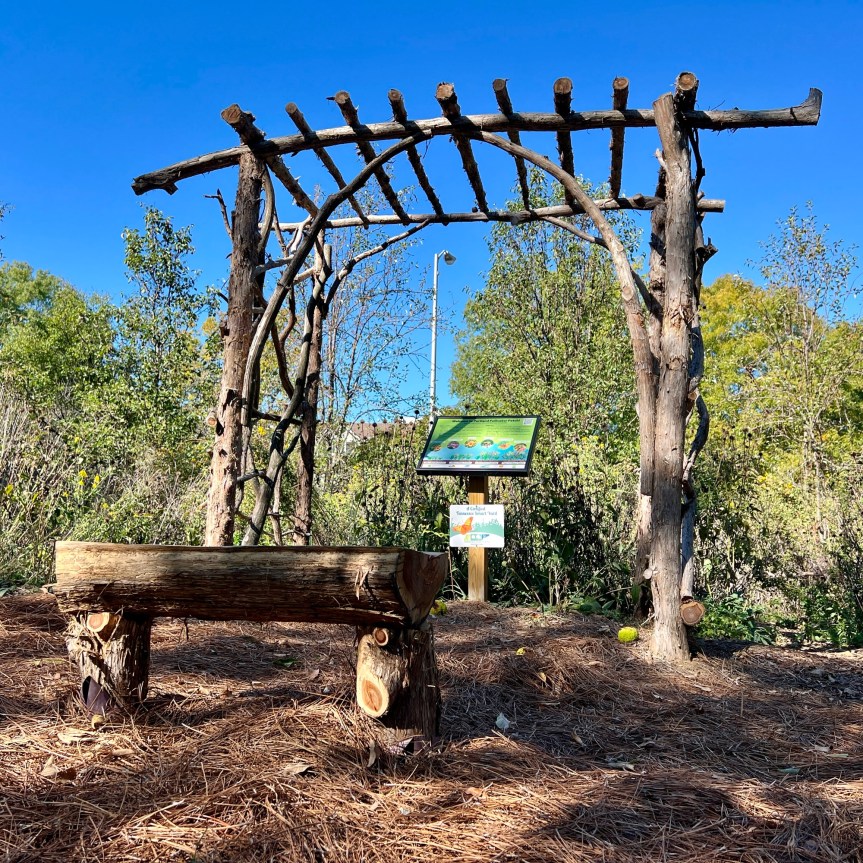
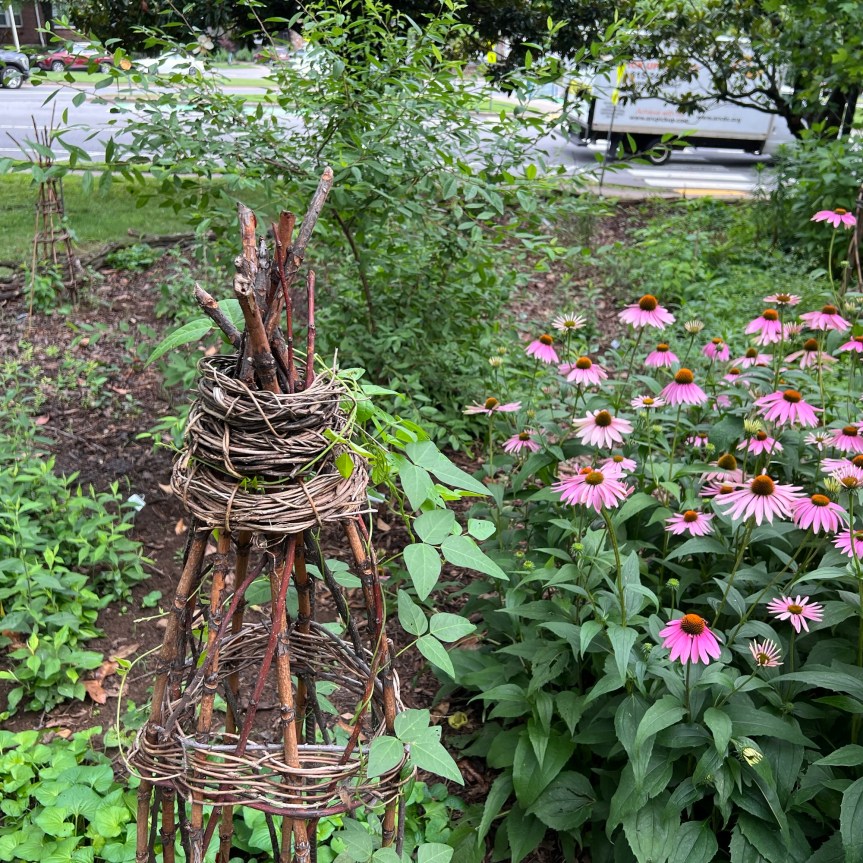
Maureen May, founder of our Second Sunday Gardeners group, reminds us that tree debris can be crafted into beautiful arbors, benches, teepees, trellises and tuteurs. Go see all these in action at Portland Park (address below). And while you’re there, note the branch borders of our Food Forest. Every time SSG gardeners visit to maintain the Pollinator patch or the Food Forest, we pick up sticks to add to the edge. In a truly sustainable property, all “waste” is welcome and put to good use.
Hugelkultur
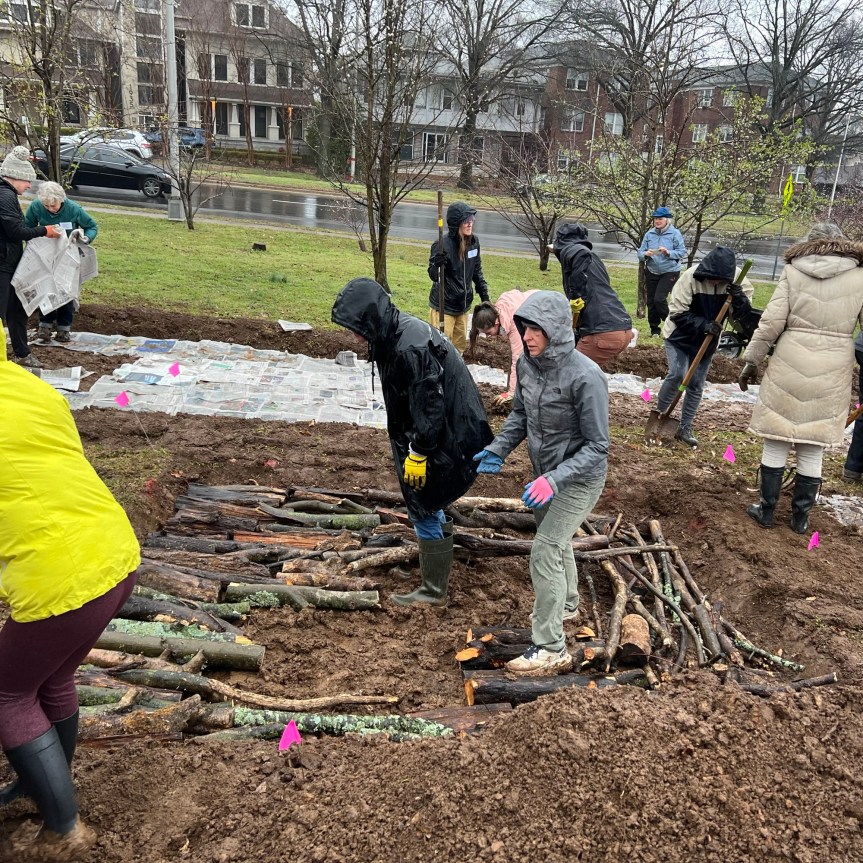
Burying wood to create an enriched, drought-resistant berm or bed can be done on a tiny scale or a big one.
Again, Portland Park has an example, but our Hugulkuture bed is hidden underneath the Pollinator Patch. Same with Maureen’s entire front yard!
Woodworkers
If you’ve got a fallen tree that woodworkers would love to get their hands on, let them know. One of my favorite local arborists told me that anything big with a burl, knot, or funky crotch might be of interest, along with the usual desirable species like black walnut, white oak, Osage orange, silver maple, and others. Don’t forget that sugarberry and hackberry make beautiful pieces, too.
Chips
If you must use a chipper truck, ask the crew to give you some chips? Wood chips are free mulch for your new replacement trees, or a weed-suppressing blanket to turn a patch of lawn into next year’s garden. They also make free, renewable path material throughout the yard. Paths direct traffic and cushion tree roots.
Sawdust
A tidy arborist will remove sawdust from a site, but if you ask, they’ll leave it. A dusting of sawdust can “lighten” compressed areas in a yard. You can compost it too, or use for weed suppression, but find out how much is too much. (Also, note that Black walnut sawdust can damage some plants, but plants resistant to juglone will be fine.)
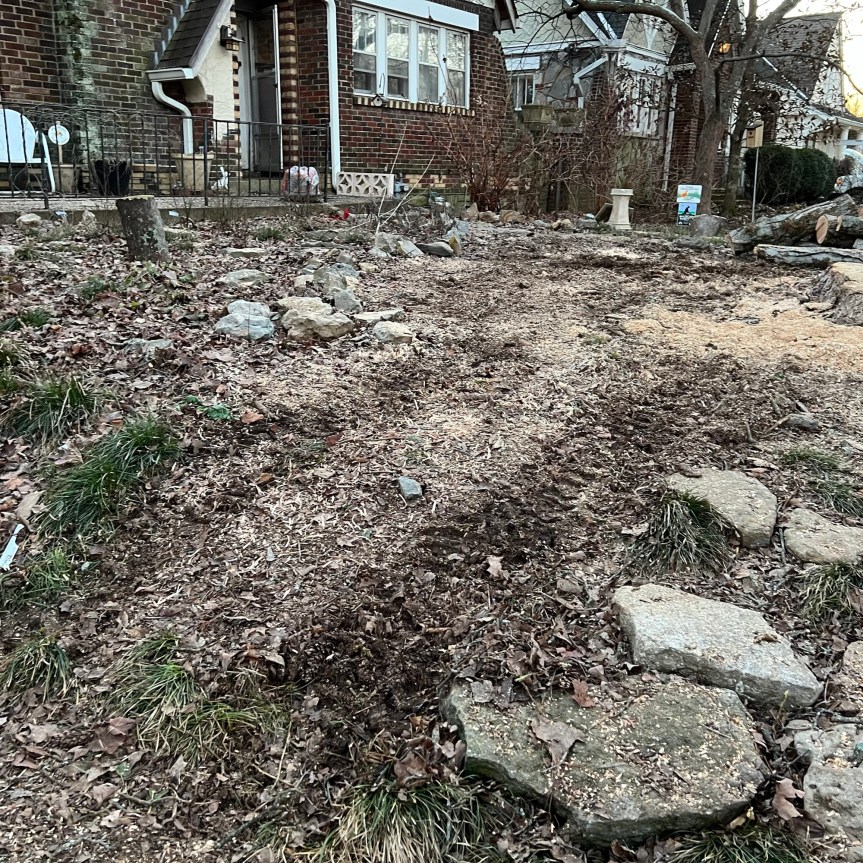
Sawdust also makes traction. I wish I’d had some when our porch was solid ice for eight solid days. Without it, I had to kneel on a cardboard box, hold on to the porch rails, and sled myself to the driveway.
This was an historic storm, but we can learn from it.
First, to use the valuable debris left behind!
Then, to ask which trees took the biggest hit and why? Structure, health, siting, species?
Which trees should we replant and why?
We need more trees, but only the right ones in the right places. Not just the species better for ice storms, but for drought and wind and weather extremes and urban pollution, all while maximizing ecosystem value and feeding birds and making butterflies. In general, the pool of eligible species will be drawn from trees not only native to our Central basin but also propagated here.
More on this next time.
Thanks for reading,
Jo
Resources
•WPLN article by Caroline Eggers about the storm, in which I get to say things: “Trees splintered, split and crashed across Nashville. Here’s how to help”
•City Cast Nashville podcast episode, in which I get to talk about trees post-ice storm: “Do You Have Downed or Damaged Trees? Nashville’s Best Naturalist Has Advice.”
•Snags and logs: good info from the National Wildlife Federation, here.
•”Dead Fence” info from UGA, here.
•Second Sunday Gardners (Nashville) facebook page, here.
•Hugelkultur info at Farmer’s Almanac, here.
•Portland Park, one of Metro’s newest pocket parks, is near Hillsboro Village at the intersection of 21st Ave. South, Portland Avenue, and Magnolia Blvd. (2050 Portland Ave, Nashville TN 37212). Want to help maintain and grow the Pollinator patch, Food Forest, and Soft Landings here? Join us at Second Sunday Gardeners!
More
SidewalkNature:
-Follow me on Instagram or Facebook, where posts are 100% nature.
-Subscribe to Sidewalk Nature to get an email when I update. I never share your info.
SUBSCRIBE
-General comment or question? Click Contact.
-Corrections, suggestions, new friends always welcome.
Bio:
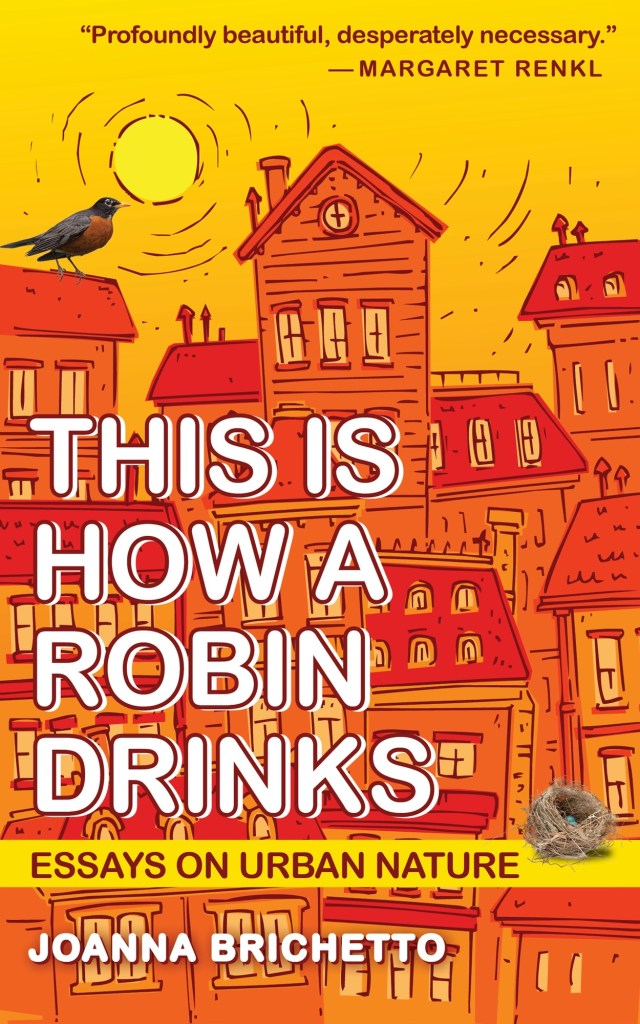
Joanna Brichetto is a naturalist and writer in Nashville. Her book, This is How a Robin Drinks: Essays on Urban Nature, is an almanac of 52 true stories about the world “under our feet, over our heads, and beside us; the very places we need to know first.” Called “Nashville’s Sidewalk Naturalist,” Jo hopes to meet all her plant and animal neighbors, and to help human neighbors add native habitat where we live, work, and play.
She’s at work on her second book, “Hackberry Appreciation Society,” and you can find her at SidewalkNature.com (“Everyday wonders in everyday habitat loss”) and on Instagram @Jo_Brichetto.
 SIDEWALK NATURE
I just love you! And we don’t mourn the loss of the tree so much as we mourn the waste of it. It hurts. Thanks for doing your part towards the solution. ♥️
~Laura
FABULOUS EMAIL!!! Thank you so much for sharing all these great ideas!
heatherlose.com
An excellent and timely article full of wonderful ideas to take this lemon of an ice storm and make life-supporting lemonade for the array of wildlife (including gardeners) that bring us so much joy. Thank you, Joanna!