
Part 1 tried to calm panic about tree damage, noise, stink, inconvenience.
Part 2 will try to stir panic, but on behalf of the cicadas.
Here’s a new yard sign I wish I could sneak all over town. Even though many of us had a “No Mow April” sign, some of us need this new one, just for a few days: “No Mow Cicada.”
**Can we please delay our obsessively tidy, short-bladed, weekly mow and blows? For another week or maybe two?**

Cicada emergence is well underway, and in some areas almost over, but our lawncare is killing them before they get a chance to mate.
It’s all about timing. These cicadas have spent 13 years underground prepping for the moment they emerge from the soil, climb a vertical thing, hang on tight, and break out of their nymphal exoskeleton. This final transition can take hours. They start to appear at dusk, but by morning many are still searching for a safe spot, or are mid-way through their final molt, or are still hanging to let their white, dough-soft bodies sclerotize into stiff, black, flight-ready condition. New adults don’t even try to fly until the sun warms them, and sometimes not until afternoon. When startled, females drop to the ground. And all cicadas are notoriously clumsy fliers.

So when a lawn crew arrives with lawnmowers, trimmers, leafblowers, pesticide sprayers, nearly all the newly emerged cicadas are doomed. Lawncare may be their most successful predator yet, and unlike the predators with whom cicadas evolved, a lawnmower does not reach “predator satiation.” A lawnmower never tires of eating cicadas. There is no end of cicadas that lawncare can kill.
Until there is an end of cicadas.
Have you walked past a tidy, short-cut lawn the morning of a cicada emergence? Many cannot find a tall, vertical thing to climb, because the turfgrass is only two inches tall. New wings unfurl to find no space to hang flat. On my morning rounds, I find hundreds of cicadas with malformed wings wandering the sidewalks near these lawns. They will never fly, never mate.
Why don’t they all crawl to the safety of the trunk of the tree that fed them? Cicadas can emerge from anywhere under and beyond a tree’s dripline (where the roots are), and may be far from the trunk, and they do not have GPS to tell them where to go.
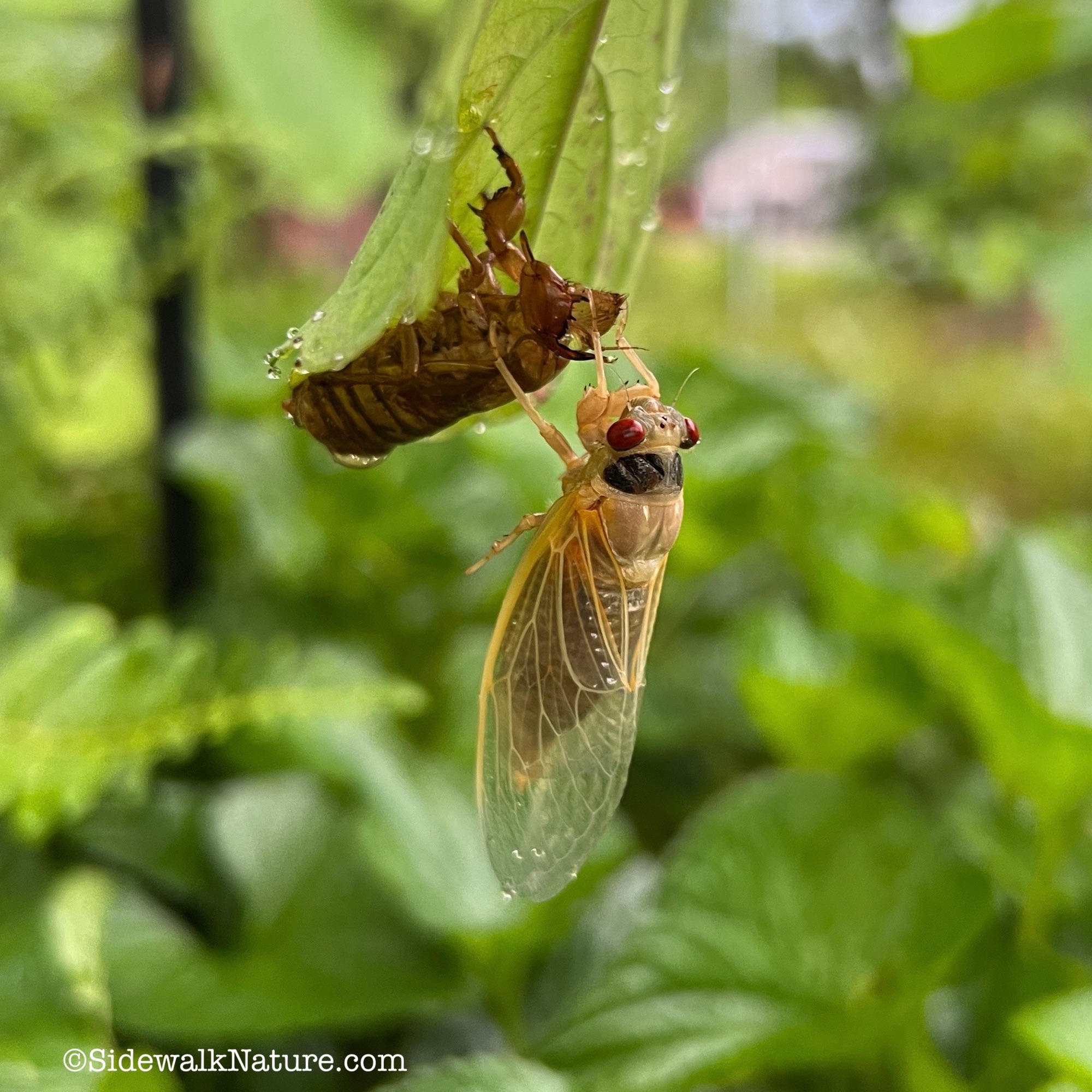
When nymphs emerge from the ground, the clock starts ticking.
When nymphs emerge from their old skin, the clock ticks faster.
They all need a safe place to hang, away from lawnmowers, trimmers, leafblowers, pressure washers, yard sprays.
Animal predators are fine: they are partly what this emergence for, but needless destruction by tidy humans is not fine.
What to do:
If you’ve got short lawn or only turfgrass, you can poke sticks into the soil where you’ve seen cicadas emerge. Think of the sticks as mini trellises or tuteurs. Forked sticks are ideal. Yard ornaments will do, as can flower pots, a spare roll of chicken wire, etc.
Remember, cicadas will stop emerging soon, and will stay up in trees to sing and mate for two or three weeks. Mowing can resume at that point, although ideally only every other week, and on a high blade (for all wildlife, and for the lawn itself), and with zero leafblowers, herbicides, fertilizers, and pesticides, including so-called “mosquito barriers.”

Meanwhile, poking a few sticks in the yard can make fine viewing areas for humans who enjoy watching the spectacle of metamorphosis first-hand.
If more people saw this metamorphosis, they’d be more inclined to help cicadas get on with their business. To help with this “regularly-scheduled miracle,” rather than hinder it.
I’m trying not to panic about cicadas, but it is difficult to stay calm and carry on when all day, every day, the sound of their singing is drowned by the sound of lawncare.

More
SidewalkNature:
Follow me on Instagram, where my posts are 100% nature, and most of it the Sidewalk kind.
Subscribe to Sidewalk Nature and get an email when I update. I never share your info.
SUBSCRIBE
For folks not on Instagram, I post nature things on Facebook from time to time.
Comment on this post, or if you have a general comment or question, click the Contact page.
Corrections, suggestions, new friends always welcome.
Bio:
Joanna Brichetto is a naturalist and writer in Nashville, the Hackberry-tree capital of the world.
She writes about everyday marvels amid everyday habitat loss at SidewalkNature.com and Instagram (@Jo_Brichetto); and her essays have appeared in Short Reads, Brevity, Ecotone, Fourth Genre, Hippocampus, The Hopper, Flyway, The Common, The Fourth River, and other journals.
Her book is forthcoming from Trinity University Press: This is How a Robin Drinks: Essays on Urban Nature.
 SIDEWALK NATURE
This piece is priceless! Thank you so much, Joanna— I want to post it EVERYWHERE!!!
_______________________________
Thank you, Mary, and please do!