
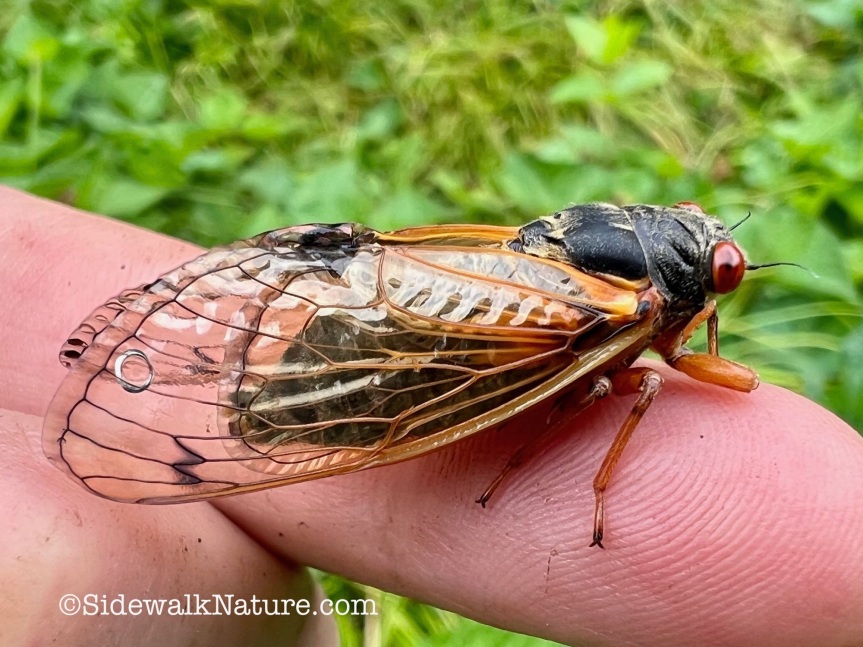
Nashville’s 13-year periodical cicadas are coming this May, but what’s already here is panic.
For months, worried people have been asking about the 2024 “invasion.” Should they cover their trees? Should they wait to plant new trees? Should they reschedule outdoor events, and even indoor events? Will there be “too many” cicadas? No. The answer to all these questions is “no.”
3 reasons not to panic about “too many” cicadas:
Reason #1: An emergence of periodical cicadas is not an “invasion.” Cicadas are not body snatchers. They aren’t even classified as pests, and they never need pesticides. They don’t eat plants, they don’t bite or sting. They are harmless, native, and weirdly cute bugs just trying to do their thing for a few days every 13 years. Their thing: emerge, fly, sing, mate, lay eggs, die.
Reason #2: Headline clickbait about 2024’s double brood” is only half the story:
“The World Hasn’t Seen Cicadas Like This Since 1803” (New York Times)
“More than a trillion cicadas will be coming to the U.S. in an event that has not happened since Thomas Jefferson was U.S. president in 1803.” (Time)
No one is getting a double brood. Yes, two different broods—a 13 and a 17-year club—will emerge at the same time, but not in the same place. They aren’t expected to overlap, but if they did, it would be in Illinois. (See map link below).
Here in Nashville, we will get our regularly scheduled 13-year cicadas, Brood XIX, right on time.
Reason #3:
Nashville’s Brood XIX emergence will not be as big as their 2011 emergence, which wasn’t as big as in 1998, which wasn’t as big as in 1985. Why? Habitat loss. To a cicada, habitat means the tree in which their mom laid eggs.
Each of this year’s periodical cicadas started life in 2011 as an egg laid in the bark of a tree. When the egg hatched, the tiny nymph dropped to the soil, found a crack, and started sucking on the roots of that tree, where it planned to stay for 13 years, growing bigger, digging deeper.
Here comes the big question that makes or breaks that cicada:
IS THAT 2011 TREE STILL HERE?
If YES: there will be cicadas.
If NO: there will not be cicadas.
Now, think of all the trees we’ve lost since 2011:
aging street trees, right-of-way trees, yard trees, tornado trees, wind storm trees, ice storm trees, “Christmas Freeze” trees, emerald ash borer trees, and all the trees cut for development and redevelopment. Plus the trees that infill let stay, but did not protect, and so died from soil compression, bark damage, or grade changes. Cicada nymphs were relying on those trees for 13 years underground. Nymphs are not DORMANT under there, they are DINING.
Without their tree, the nymphs starve.
Kill the tree, kill the cicadas.

I look at yards in my neighborhood where in the last 13 years, every tree was removed to expand a home’s footprint, and to add the obligatory “additional dwelling unit” (garage, studio, etc.) as well as the impervious-surface patio and driveway in between. Cicadas that had been present in the soil before infill, are gone.
Every yard and neighborhood is different, but redevelopment means more habitat fragmentation, more environmental pressures, fewer mature trees and fewer cicadas.
This is the right reason to panic.
Cicada Comeback?
However, here’s another good reason not to panic: new trees. New trees can make new cicadas. When Brood XIX survivors emerge, they might fly near healthy, new trees planted in full sun, and with twigs as thick as a pencil, which is what females want when time to lay eggs.

Since the last periodical emergence, Nashville has made it a lot easier to get new trees, thanks to Root Nashville’s goal to plant 500,000 by 2025, and thanks to their many “tree partners,” public and private, large and small.
Last month, a few blocks of my daily commute suddenly grew 43 new trees. 43! Mulched correctly with “donuts,” not “volcanoes”! And they aren’t just 43 clones of a single exotic species marching down the street (like somewhere else in town…), but a wide range of species, including Pawpaw, Eastern red-cedar, Swamp white oak, Nuttall’s oak, Carolina cherry laurel, and Tulip poplar!
In fact, all but a handful of the 43 are native to the area, so they’ll be able to support countless creatures in our local foodweb, as well as just stand there and look beautiful while they sequester carbon, prevent erosion, filter stormwater, create oxygen, shade the sidewalk, and clean the air.
Aren’t we lucky?
As lucky as the cicadas who find them this spring, and whose eggs will have a good chance to make it to adulthood 13 years from now.
I’ll write a Brood XIX update later, with tips on HOW TO OBSERVE THE HECK OUT OF THEM, especially when they transform from creatures of the soil to creatures of the air. (Hint: get a UV flashlight.)
But for now, here’s a list of
frequently asked Cicada questions / FAQ:
- Should I reschedule an outdoor event? No. Even a diminished emergence will add a magical, epochal, unforgettable element to your event.
- Should I reschedule an outdoor nighttime event? No. Cicadas don’t sing at night.
- Should I SCHEDULE an outdoor nighttime event? No one asks me this, but YES, and bring a UV flashlight so you can watch the nymphs emerge before dawn, crawl up the nearest sturdy thing, split from their exoskeletons to hang vertically while their new wings extend and harden, while their bodies morph from ghostly white to gorgeous black.
- What do cicadas want? To emerge safely, complete their molt, and live long enough to sing (if male), mate, lay eggs (if female), enjoy life aboveground for a few days.
- What are cicadas good for? Your ecosystem. All life on this planet. They feed everything with a mouth. Their tunnels aerate the soil and increase water infiltration, and their decomposing bodies add nutrients to the soil. Their “patience,” beauty, and mystery have inspired art and science for as long as there have been people to be inspired. And, they were “all part of life’s rich pageant” before we were.
- Will they bite or sting me or my pet? No.
- Will they eat my plants? No. They can’t eat solids.
- Will they eat my tree? No, but adults will suck some sap from bark (harmlessly). Will they eat my tree? No, but adults will suck some sap from bark (harmlessly). Please see tree note below.
- Will they prune my tree? Maybe, but it’ll be fine.
- Will they kill my tree? No.
- Should I wait till next year to plant a tree? No.
Next year a brood of 17-year cicadas is coming (Brood XIV). Besides, the trees we plant are already at nurseries, and nurseries get cicadas, too.
- Should I net my tree? No, unless you want to accidentally trap birds and other creatures, and to damage your branches with the weight of the sheeting.
- When will Brood XIX emerge? When soil 8 inches deep is 64 degrees, especially after a soaking rain. For us, it’ll likely be early May. (Last year’s XIX “stragglers” arrived May 10.)
- How long will Brood XIX be here? 4-6 weeks, max. After emerging, it takes a few days to gear up and sing / mate. Chorusing: expect about 2 weeks of crescendo, 2 weeks of decrescendo.
- How are periodical cicadas different from annual cicadas? In Nashville, up to 9 different species of “annual” cicadas emerge every summer after spending 2-3 years underground as nymphs.
- Why do periodical cicadas emerge in large numbers? To overwhelm predators so that enough cicadas survive to make more cicadas. It’s called “predator satiation.”
- What if I’ve never experienced an emergence, so the predictions of fewer cicadas “this time” are meaningless to me?
Go for it! Experience it to the fullest. Compare what you see at home / work to local areas with old trees in sunshine, and then watch, listen, celebrate, and record what you observe.
Upload observations to iNaturalist and Cicada Safari.
Let’s make “extinction of experience” extinct! (When successive generations take for granted the gradual diminishment of species richness and abundance.)
Still Worried About Your Trees?
If my cicada-loving advice didn’t convince you, how about advice from a local authority whose business depends on avoiding tree damage?
I asked Terri Barnes of GroWild (link), one of the “leading native plant nurseries in the eastern U.S.” if she was worried about Brood XIX. GroWild sells hundreds of different species and cultivars of native trees and shrubs in containers that range from 3 gallons to 25, some of which are up to 12 feet tall. Outside, under the sky, no protection. They’ve been propagating these “woodies” along with perennials, wildflowers, vines and grasses long before the last Brood XIX emergence.
Here is her answer:
“Nature and cicadas have lived together for more years than I care to count!
Consider it a way that nature tip-prunes trees and shrubs. The result is a thicker branching the following year. We have never had anything die as a result and we do nothing to prevent it.”
–Terri Barnes, GroWild.

RESOURCES:
–For all things Brood XIX and other cicadas, visit CicadaMania, and preferably on a computer so your cursor (temporarily) becomes a cicada!
Here is their 2024 forecast w/ MAP of the double broods: link.
–RootNashville.org, link.
–Community science:
Report cicada observations to two free community science apps:
-iNaturalist (photo and/or audio), link.
-Cicada Safari (photo and/or video inside the app), link.
Photos of the undersides of adults help experts identify the species.
–Articles to convince you to love cicadas:
-“Cicadas are Delightful Weirdos you Should Learn to Love, “Smithsonian. link.
-Margaret Renkl’s 2021 article about that year’s brood (not in TN):
“The Cicadas are Coming, It’s Not an Invasion. It’s a Miracle.” link.
and
– SidewalkNature’s “Cicada Magic:” a 2023 post about Brood XIX early-bird “stragglers” link.

More
SidewalkNature:
Follow me on Instagram, where my posts are 100% nature, and most of it the Sidewalk kind.
Subscribe to Sidewalk Nature and get an email when I update. I never share your info.
SUBSCRIBE
Some people aren’t on Instagram, so I post nature things on Facebook from time to time.
Comment on this post, or if you have a general comment or question, click the Contact page.
Corrections, suggestions, new friends always welcome.
Bio:
Joanna Brichetto is a naturalist and writer in Nashville, the Hackberry-tree capital of the world.
She writes about everyday marvels amid everyday habitat loss at SidewalkNature.com and on Instagram (@Jo_Brichetto); and her essays have appeared in Creative Nonfiction, Brevity, Ecotone, Fourth Genre, Hippocampus, The Hopper, Flyway, The Common, The Fourth River, and other journals.
Her almanac of short essays is forthcoming from Trinity University Press, and is called This is How a Robin Drinks: and Other Essays of Urban Nature.
 SIDEWALK NATURE
FABULOUS post!!! You are a Nashville treasure, and I hope your readership extends a whole lot beyond Nashville!
Thank you, Mary!
Wow! I loved it and I now know way more about cicadas than I ever have.
Thank you for posting so much valuable information!
Thank you so much! I’ll share this well-researched (as always) article with friends. It bears repeating!!