
Today’s Front Door Nature: A little clue to a big change.
I saw the tiny, black blip this morning. On the porch, by my feet. Picked it up, and knew it was the last molt of a Pipevine Swallowtail caterpillar: the old, squashed skin (and face!) that drops when a caterpillar becomes a chrysalis.
So, I looked up. And there was the chrysalis, fresh and glistening, above my head on a brick in the doorway.

But the best part was when I made my kid “look at the black blip,” and then he too, looked up. He looked to find the butterfly-in-progess who dropped it. He knew.
The wad of caterpillar skin tells a big story. It’s the story of a native plant / animal interaction, and of the astonishing specificity of a larval host plant.
The host plant here is Wooly Pipevine (Aristolochia tomentosa), and it covers our porch rail. Native Pipevines are the only plants a Pipevine Swallowtail butterfly will lay eggs on because they are the only plants the caterpillars can eat. They’ve evolved together, in the habitat native to this place.
This is why I grow plants that make new butterflies. And why we knew what the blip was.

A butterfly host plant at the door means we get to see—just by taking a few steps outside—every life-cycle stage all summer. It’s an ideal Show and Tell for why native plants matter.
More info:
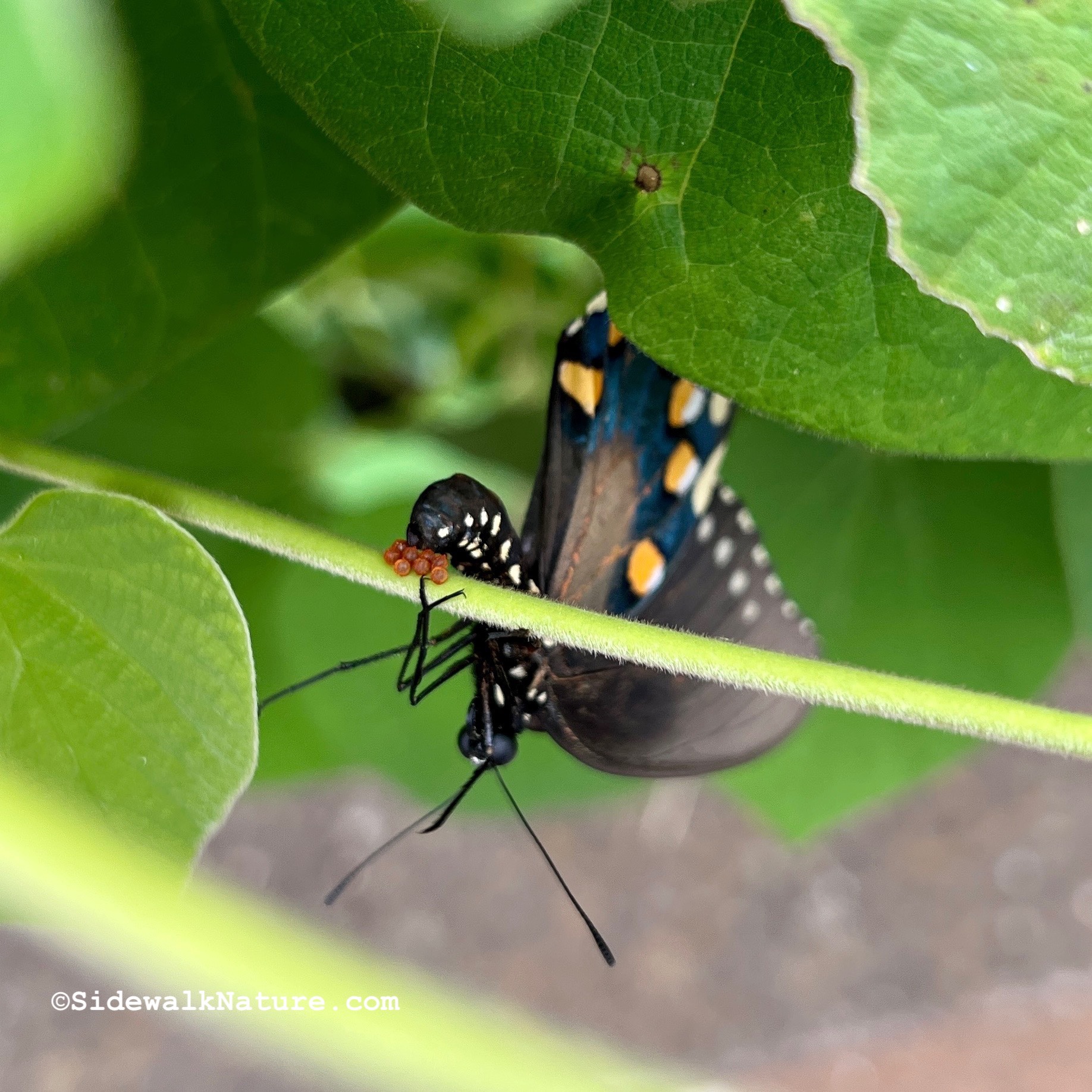
Local Pipevine Swallowtails can use Woolly Pipevine (Aristolochia tomentosa) and Big-leaf Pipevine / Dutchman’s Pipe (A. macrophylla) as host plants. Females search for these plants when time to lay eggs. They lay multiple eggs in one spot, and it is amaaaazing to watch the hatchlings emerge, eat their eggshells, and then start eating the same leaf at the same time.
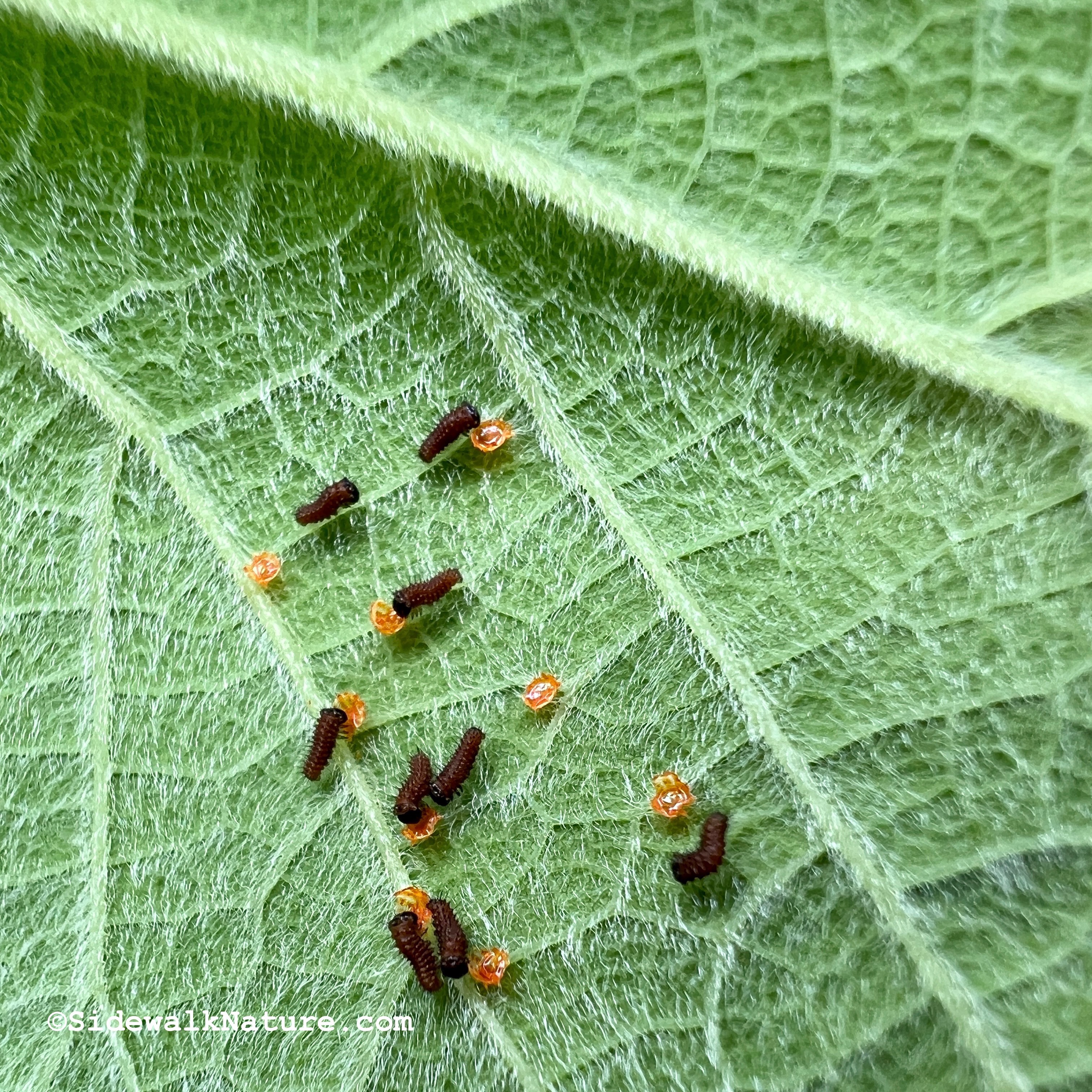
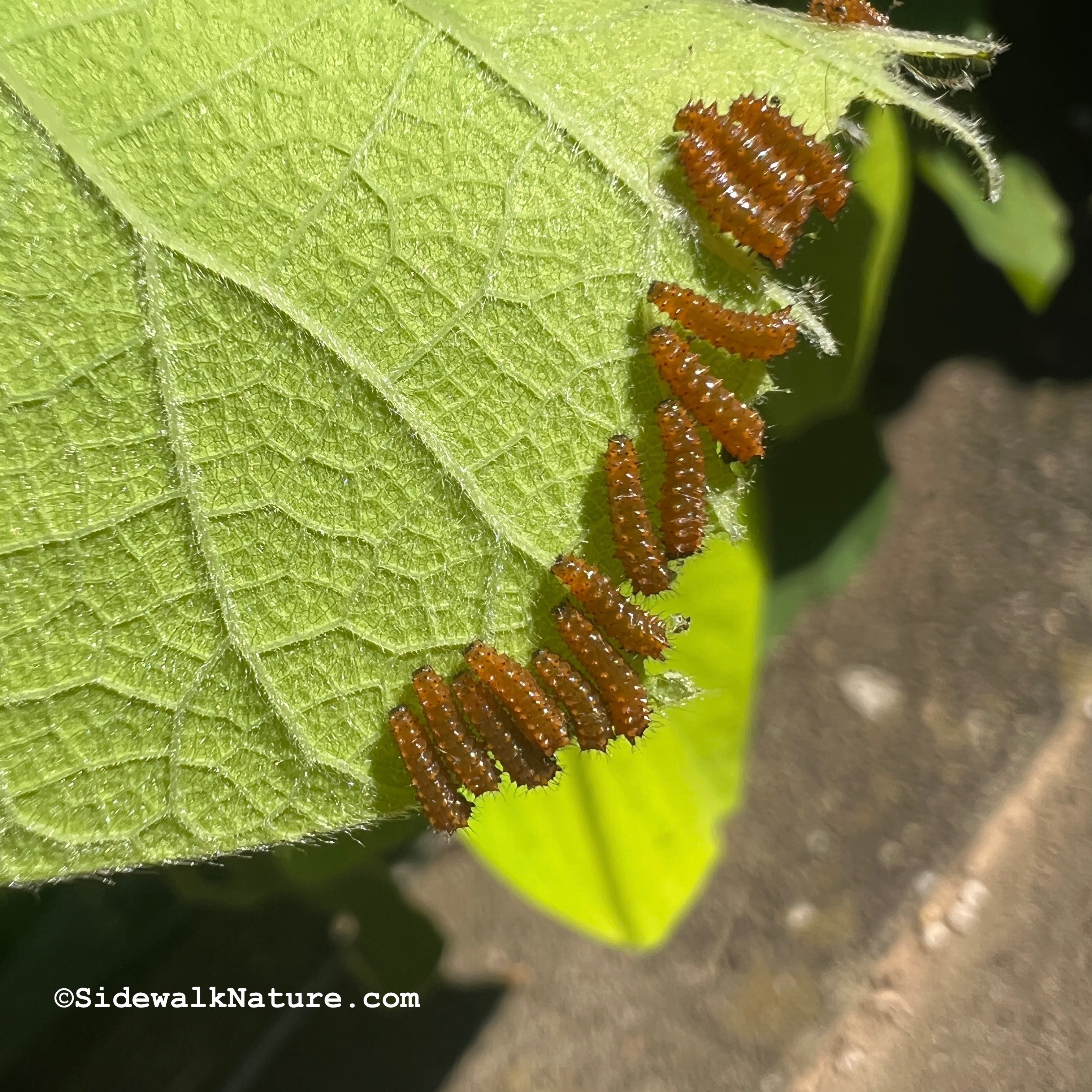
Siblings hang out together as they get bigger and bigger, and even when they are fat, fifth instars, they don’t seem to mind each other’s company.

If you get too near, a Pipevine caterpillar deploys their osmeterium to scare you. It pops out from the top of their head: a bright yellow Y-shaped organ, accompanied by a mild stink. If you still don’t back off, they simply drop from the plant. But both defense tactics take lots of energy, so it’s best to admire from a distance.

Adult Pipevine Swallowtails drink nectar from many different flowers. The University of Florida entomology dept. says “Pink and purple flowers (e.g., phlox [Phlox species], ironweed [Vernonia species], and thistles [Cirsium species]) are particularly attractive to pipevine swallowtails (Scott 1986). “
Lookalikes
Nashville has several species of black swallowtail butterflies, and they can look alike. When I see a dark swallowtail, I usually have to stare and stare to confirm which species: Pipevine Swallowtail? Spicebush Swallowtail? Black Swallowtail? The black morph of a female Eastern Tiger Swallowtail? Or even a Red-Spotted Purple?

But there’s a trick to ID the Pipevine butterfly at a glance. They flutter as they feed. The whole time they sip nectar from a flower, their wings keep moving. The lookalikes don’t do that.
The lookalikes look like Pipevine Swallowtails on purpose. They’ve evolved to mimic the latter because predators know that Pipevine Swallowtails taste terrible and are full of toxins (from the toxic Pipevine plant). Batesian mimicry. The other species benefit when predators associate them with a food not worth fooling with.
And even though all these dark swallowtails may look alike, they each have their own set of host plants.
Links / Resources:
Great pics and info on Pipevine Swallowtail are at the University of Florida entomology page (link here).
From that site: “Aristolochia species are commonly known as pipevines or Dutchman’s pipes because the flowers of some species are shaped like tobacco pipes.”
Another host plant is Virginia snakeroot (Aristolochia serpentaria) which I’ve never seen for sale, and only found wild in (protected) woods a few times. (This is not White Snakeroot / Ageratina altissima.)
more
SidewalkNature:
Follow me on Instagram, where my posts are 100% nature, and most of it the Sidewalk kind.
Subscribe to Sidewalk Nature and get an email when I update. I never share your info.
SUBSCRIBE
I’m not fond of facebook, but some people aren’t on Instagram, so I post nature things there from time to time.
Comment on this post, or if you have a general comment or question, click the Contact page.
Corrections, suggestions, new friends always welcome.
Bio:
Joanna Brichetto is a naturalist and writer in Nashville, the Hackberry-tree capital of the world.
She writes about everyday marvels amid everyday habitat loss at SidewalkNature.com and on Instagram (@Jo_Brichetto); and her essays have appeared in Creative Nonfiction, Brevity, Ecotone, Fourth Genre, Hippocampus, The Hopper, Flyway, The Common, The Fourth River, and other journals. An almanac of urban nature encounters is forthcoming.
 SIDEWALK NATURE
I can’t believe their heads fall off. When the gulf fritillary caterpillar’s head fell off, I thought that I’d killed it!
You saw it happen? I was hoping your hard work would pay off!