
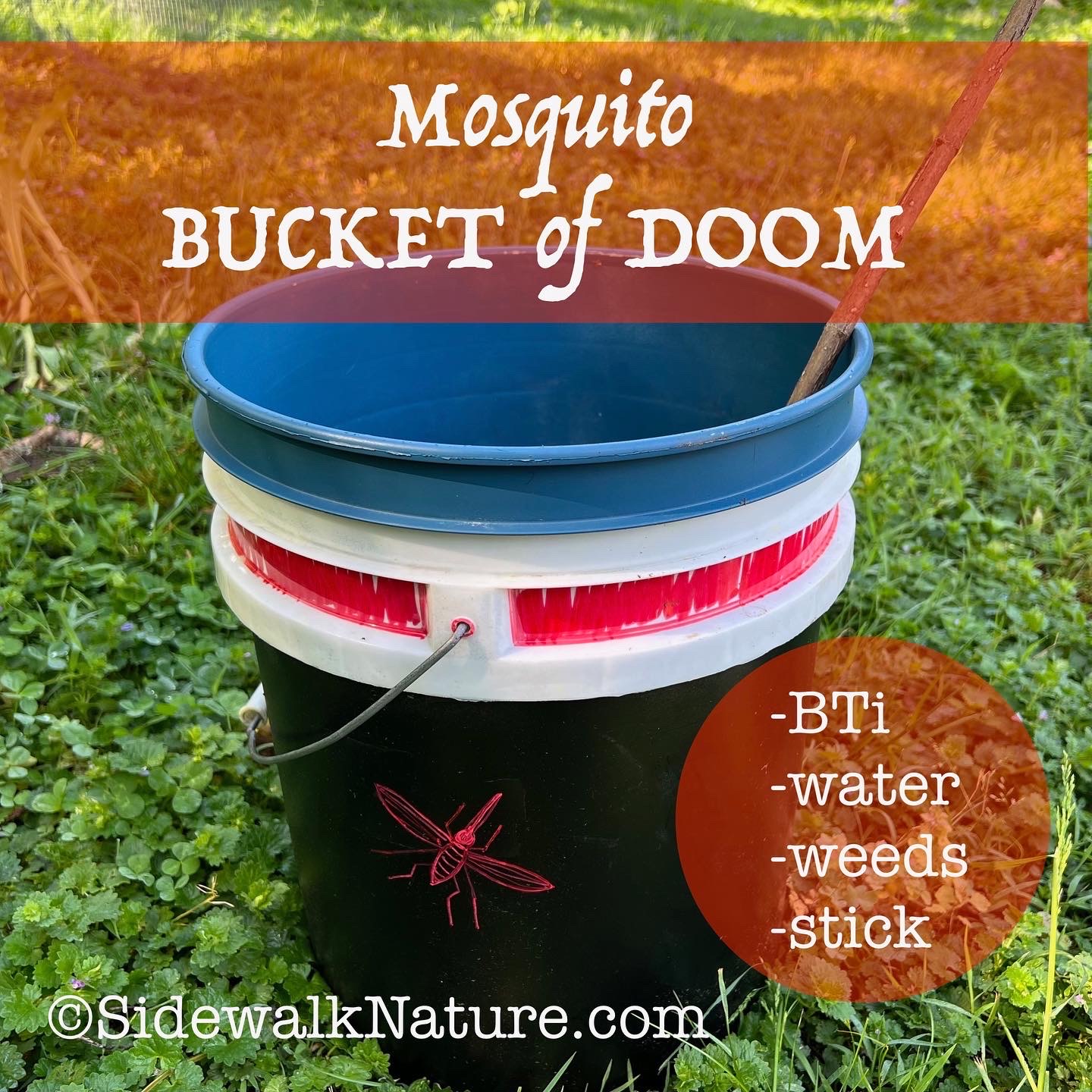
Mosquito season is here! Instead of spraying pesticides onto our entire yards—and onto fireflies, ladybugs, bumblebees, and butterflies—why not kill *only* mosquitoes?
But first: let’s PREVENT mosquitoes from breeding in our yards. Get rid of all standing water at least once a week: in plant saucers, trash cans, toys, and gutters.

Then, let’s CREATE standing water, but only in a Mosquito Bucket of Doom.
It’s a safe, cheap, easy way to control mosquitoes, and more effective than sprays and foggers.

Bti dunks are a larvicide that kills the larval stage of mosquitoes—the hatchlings—captive in the one place you’ve made it possible for mosquitoes to lay eggs: the standing water in your Mosquito Bucket of Doom.
Compare this to pesticide sprays, barriers and foggers: adulticides that cannot target one particular creature. All pesticide sprays—even “natural” and “organic”—hit and drift onto nearby plants and creatures, including pets and people. Sprays also contaminate our stormwater, drinking water, and soils.
A “Mosquito Bucket of Doom” is just
a bucket of water +
handful of grass +
a stick +
a Bti dunk.
–How it works:
The grass in the water releases carbon dioxide to attract mosquitoes ready to lay eggs, but the Bti dunk in the water kills all larvae soon after they hatch.
Bti will not harm anyone else: fireflies, bees, birds, butterflies, frogs, fish, mammals, pets, and people are safe.
Bti dunks are sold at hardware and garden stores, and for decades have been used in stock tanks, ponds, ditches, and rain barrels.
–The name “Mosquito Bucket of Doom:”
In 2021, a video from Doug Tallamy at Homegrown National Park showed how to use Bti in bucket to control mosquitoes. I tested and tweaked it for a year—and added the triple-function stick—and then named it “Mosquito Bucket of Doom” in May 2022.
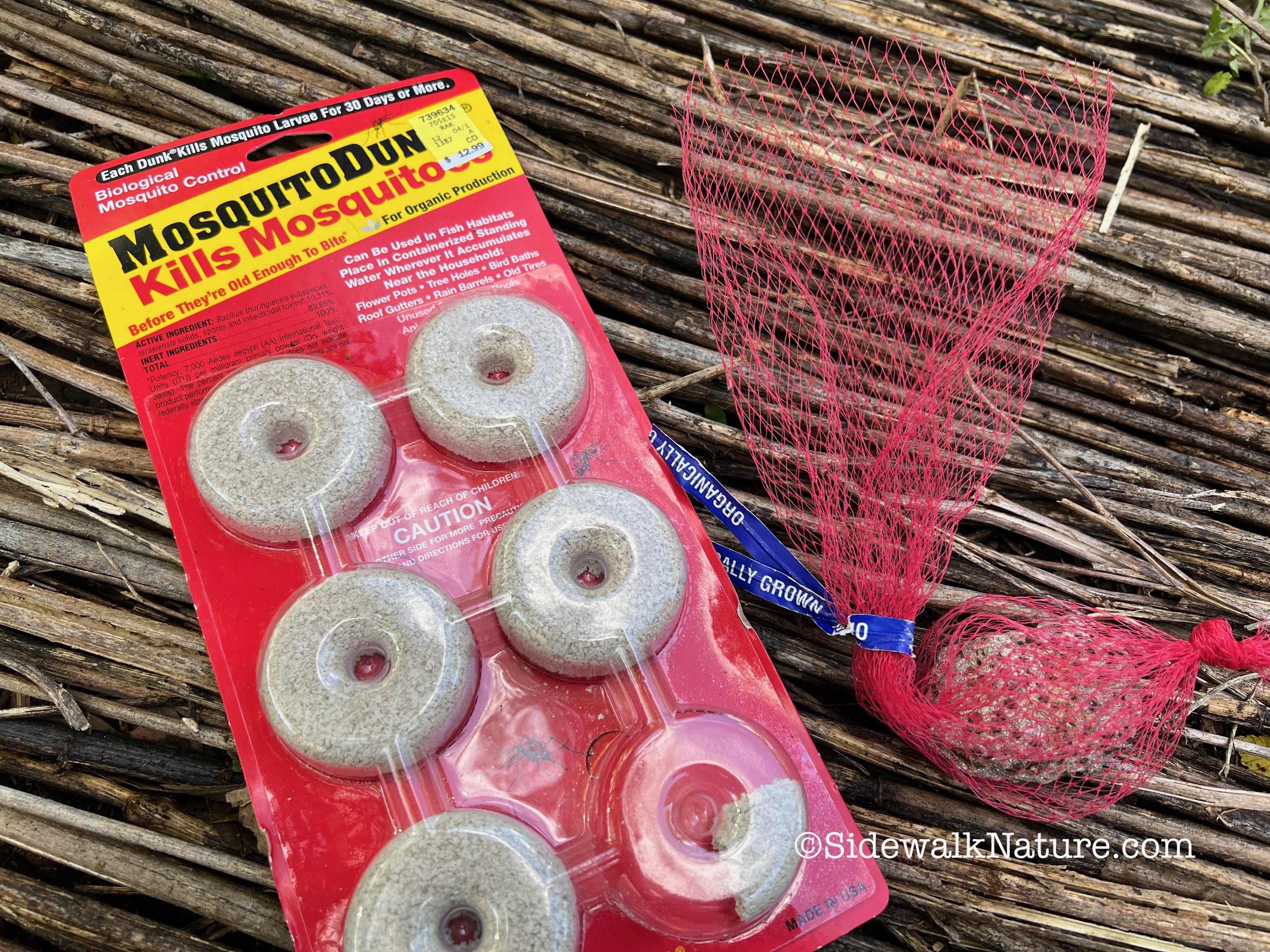
–How long will a dunk last? One dunk treats 100 square feet of water surface for at least 30 days. Using one dunk per bucket is fine, but you can save money by breaking the dunk into four pieces, and adding one quarter-piece (¼) to your bucket each month. Set a calendar alert if necessary.
–How much water? Fill the bucket only half full. Some mosquitoes lay eggs above the water line, where they hatch when submerged by rising water. This is one reason to add a stick: it acts as a woody substrate to invite oviposition. Some mosquitoes lay eggs directly on the water as small, black rafts (with 200 eggs each!), but others lay eggs one at a time, too tiny to see.
You may see eggs and larvae (the “wigglers”), but an active Bti dunk means there will be no pupae (the “tumblers”).
–How many buckets?
Start with one, increase as needed. Site exposure, elevation, size, airflow, vegetation, and how nearby properties deal with standing water mean every yard is unique.
**Show your neighbors what you are doing and why. Print the pdf flyer (linked below) and share!**

–Where to place a Mosquito Bucket of Doom: Ideal placement is where mosquitoes hang out anyway: in moist shade where there isn’t a lot of wind. If all you have is full sun, put it near an object (house, shed, trash can) that will cast shade at some point of the day.
How far from where people sit? Keep at least a few meters away. The bucket’s job is to be the only standing water on your property so it can attract mosquitoes ready to lay eggs.
–MODIFICATIONS
to maximize DOOM and minimize collateral damage:
–Stick / Escape Ramp:
1) A stick is an escape ramp. We don’t want any creatures to drown: birds, chipmunks, squirrels, bumblebees, etc. Even if you cover the top of the bucket with wide-mesh wire, it will still need a stick that reaches the rim. (See below for Child Safety Warning.)
2) A stick also acts as a woody substrate for mosquito species that prefer to lay eggs above the water line. When the water rises, eggs will hatch and larvae will die.
–Floaters vs Sinkers:
Floaters vs Sinkers: Dunks float. This is fine unless a curious animal or human removes it, or if it floats out of the bucket during a hard rain. (Drill overflow holes near the top if needed.)
To make a sinker, cut a circle from a mesh veggie bag, tuck the dunk inside, twist the bag shut and attach to the bottom of your stick with a twist-tie. The stick makes it easy to lift and replace the dunk every month.

–Cover Option: A layer of chicken wire or wide-mesh hardware cloth can keep the dunk from disappearing. Don’t use fine screening that mosquitoes cannot pass through.
–Color Option:
Colors attract mosquitoes AFTER they’ve detected the carbon dioxide that we exhale, and that our Buckets of Doom off-gas. The smell is enough, but adding color can help. But which color?
Black attracts mosquitoes, and a recent article confirms this, but also tests other colors. Winners are black, red, orange, cyan. High contrast is also good.
“We find that CO2 induces a strong attraction to specific spectral bands, including those that humans perceive as cyan, orange, and red.” (link to study.)
–WHAT IF:
every yard in a neighborhood stopped the expensive and deadly pesticide foggers / barriers / yard sprays to opt for a Mosquito Bucket of Doom?
Imagine how many more fireflies and
butterflies and
bumblebees and
birds we’d have!
Let’s make a BUCKET of doom BRIGADE!

CHILD SAFETY: If there is the remotest possibility that a small child will ever be near your bucket, you must *securely* cover the bucket.
“The U.S. Consumer Product Safety Commission (CPSC) warns that buckets filled with water or other liquids, especially the large five-gallon size, present a drowning hazard to small children.”*

Links:
-*PRINTABLE pdf instructions (1-page, b/w) to keep, post, share: link
-color flyer of instructions, thanks to Ghertner & Co.: link.
-SidewalkNature post: “Doom-it-Yourself” (different STYLES of buckets), including these:
-SidewalkNature post: “Don’t Forget the Stick (Bucket of Doom)”
-Video of Doug Tallamy on the Bti bucket trick: link.
-Xerces Society: “Protecting Pollinators from Pesticides:” link.
-“What you need to know about Bti” from the CDC: link.
-Mosquitoes and colors study: link.
-Child Safety quote about buckets in general is taken from this link.
-Disclaimer / Use at Your Own Risk / info from SidewalkNature: link.
-Proof that 1/4 of a dunk works (Mosquito Dunk Study results): link.
-“15 mosquito-control strategies and devices that don’t work”: link.
-“Effects of mosquito sprays on humans, pets, and wildlife” (article by Colin Purrington): link.
more
#SidewalkNature:
Follow me on Instagram, where posts are 100% nature, and most of it the Sidewalk kind.
Subscribe to Sidewalk Nature and get an email when I update. I never share your info.
SUBSCRIBE:
For people who aren’t on Instagram, I post nature things on Facebook from time to time.
Comment on this post, or if you have a general comment or question, click Contact.
Corrections, suggestions, and new friends always welcome.
BIO:
Joanna Brichetto is a naturalist and writer in Nashville, Tennessee. Her book, This is How a Robin Drinks: Essays on Urban Nature, is an almanac of 52 true stories about the world “under our feet, over our heads, and beside us; the very places we need to know first.”
As “Nashville’s Sidewalk Naturalist,” Jo hopes to meet all her plant and animal neighbors, especially the ones able to eke out a living in our most inhospitable places. She’s at work on her second book, “The Hackberry Appreciation Society,” and you can find her at SidewalkNature.com (“Everyday wonders in everyday habitat loss”) and on Instagram @Jo_Brichetto.

This is How a Robin Drinks: Essays on Urban Nature is available at online retailers, Bookshop.org, libraries, and hopefully an indie bookshop near you.
 SIDEWALK NATURE
You are a GENIUS! I’m sending this to everyone I know, esp in this neighborhood!
Thanks!
mcs
Thank you for spreading the word, Mary!
Good, “no-brainer” info! (Having used dunks in stock tanks for years, I thought this was common knowledge. And cattle, horses, and sheep leave hay bits in the the water- so no grass addition needed 🙂)
Thank you so much! I’ll be sharing this one too!!
Dear Mosquito Jo,
Thank you for your very interesting post concerning the mosquito bucket of doom. I hope a lot of people give it a go and report back in the comments with effective tweaks.
Me too, Richard. I love getting email/text photos of finished buckets so I can suggest any changes right away, to promote maximum Doom!
Five gallon buckets with water can be deadly for toddlers. Precautions should be taken.
I’ll add the warning to the DIY. Thank you.
I’ve read that I should change the water/hay monthly. What do you think? And if yes, if I pour out the water, will I be allowing some mosquito larvae to hatch? I’m going to try to pour it out near a drain, if possible.
Hi, Sally. Different species of mosquitoes respond differently to the types, amounts, and ages of the biomass, so I just add a few bits of new plant material once a month (when I’m replacing the BTi dunk). I don’t dump my buckets: they are under trees and don’t get above 1/2 full, and the accumulating algae will attract mosquitoes ready to lay eggs. If you do pour the water out, any existing larvae will die when deprived of standing water (assuming the water is poured onto dry yard / lawn). Some eggs may also get poured out, but these won’t produce adults unless they land where there will be standing water for at least a week at a time. So, it’s fine to pour and restart monthly if this is the method that works for you and your area!
How do you prevent the bucket from overflowing with rain water?
If the bucket material allows, you can drill / poke small overflow holes about 3″ from the top, but I haven’t had an overflow problem because 1) the initial height of water in the bucket is only a few inches and 2) the buckets are positioned under shade trees. The shade keeps the water cool enough to attract pregnant mosquitoes. In my tests, buckets in direct sun here in Nashville get too hot — over 100 degrees. This temp will kill the larvae, which is our goal, but it can also convince a mosquito to go somewhere “safer” to lay eggs.
Hello! My bucket of doom has been going for about a month. It is absolutely fascinating to see it in action. Eggs have hatched and there are little beings swimming in the water. I have half of a mosquito dunk in the bucket. To be certain I am doing this correctly, will there be some larvae alive in the water for a short time before they die? Or should the dunk kill the larvae upon hatching? I do not want my bucket of doom to be a mosquito factory.
Hi, Holly, I’m glad to hear you are enjoying the experiment! Yes, the larvae do hatch, because BTi doesn’t affect the eggs. In my tests, the newly-hatched larvae only survive for a few hours (my average is about 3 hours). This means you could see live larvae / Wrigglers at any time. But because the dunk kills the larvae before they can advance to the next life-cycle stage, the bucket should never have pupae / Tumblers present. (The CDC.gov illustration in my post shows what the two stages look like, but I think the pupae look like little commas or shrimp.)
Thank you for your response. I am happy to know that my bucket is working the correct way!
This is fascinating! I’m thinking of trying SOON.
I’m curious if the bucket of doom attracts more mosquitoes to an area than would otherwise occur (akin to Japanese beetle traps/)?
I absolutely get swarmed (and bitten-), but they don’t itch me as much as they do for my kids.
Also- do you have any genius black fly tricks?!
Thanks!
Hi, Gillian, Yes, any stagnant water will attract mosquitoes, including the water in Buckets of Doom, so I’d advise placing the Buckets in areas that aren’t immediately adjacent to human sitting / living spots.
I don’t have personal experience with Black Flies, which is a common name for many different species, but any Dipteran in the same suborder w/ mosquitoes will also be killed in their larval stage by BTi. You can google “Black flies” and “BTi” to read studies.